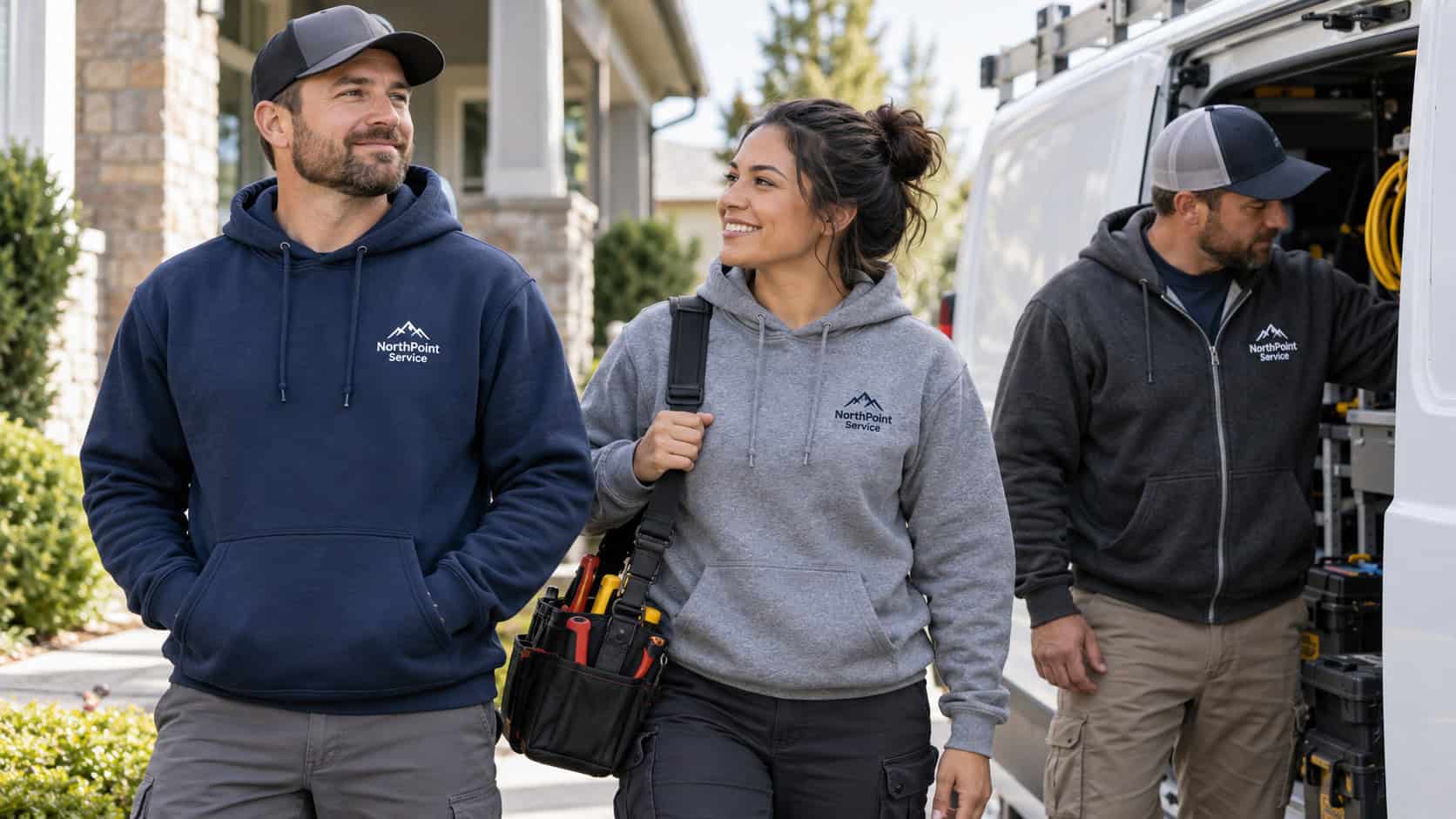
Company hoodies for employees can fill an important gap between everyday work shirts and heavier outerwear. They give crews an additional branded layer for cool mornings, warehouses, service calls, outdoor work, events and casual customer-facing environments.
The challenge is choosing the right hoodie.
A heavyweight pullover that works well for an outdoor crew may be unnecessarily warm for warehouse employees. A full-zip hoodie can make temperature changes easier to manage, while a pullover provides an uninterrupted front and a traditional sweatshirt feel. Embroidery can create a polished left-chest logo, while printed decoration may make more sense for larger or more detailed graphics.
For a business buyer, the best hoodie is therefore not simply the thickest or least expensive option. It is the garment that fits the employee’s role, work environment, branding requirements and uniform program.
Quick Answer: What Type of Company Hoodie Should You Choose?
Choose the hoodie around how employees will actually wear it. A midweight pullover is a versatile starting point for many teams. A full-zip hoodie works well when employees frequently add and remove layers. Heavyweight hoodies make more sense when additional warmth and a substantial garment are priorities. Lightweight options can work well indoors, during transitional weather, or for employees who need an easier layering piece. Then match the decoration method and logo placement to the garment, artwork and intended appearance.
Why Hoodie Selection Matters in a Business Uniform Program
A company hoodie often becomes one of the most frequently worn pieces in a cool-weather uniform.
That makes garment selection important.
If employees are given a hoodie that is uncomfortable, too warm, too light or inconvenient for their work, they may substitute personal sweatshirts and jackets. Once that happens, a coordinated uniform program can quickly become a mixture of different colors, brands and styles.
A better approach is to treat hoodies as part of the broader uniform system.
- An HVAC company might use work shirts as the primary uniform and branded hoodies as an insulating layer during cooler service calls.
- A landscaping company might issue hoodies for cool mornings while keeping jackets available for wind or rain.
- A warehouse might use lighter hoodies where employees need warmth without bulky outerwear.
- A restaurant might reserve branded hoodies for delivery staff, outdoor event crews or casual back-of-house roles rather than every position.
- A school, nonprofit or event organization might prioritize comfort, broad sizing and easy repeat ordering.
If you are building more than one piece of employee apparel, C2W’s guide to creating a small-business uniform program explains how shirts, polos, hoodies and outerwear can work together instead of being ordered as unrelated items.
Pullover vs. Zip-Up Hoodies for Employees
One of the first decisions is whether employees need a traditional pullover or a full-zip hoodie.
Neither style is automatically better. The practical difference is how the garment fits into the workday.
| Consideration | Pullover Hoodie | Full-Zip Hoodie |
|---|---|---|
| Putting it on/off | Must be pulled over the head | Easy to open or remove as temperatures change |
| Front decoration | Continuous front except for the pouch pocket area | Center zipper affects designs that would otherwise cross the front |
| Layer adjustment | Less adjustable during the day | Can be worn open, partly zipped or fully zipped |
| Typical business use | Crews wanting a straightforward, consistent sweatshirt | Employees moving between temperatures or layering frequently |
When a Pullover Hoodie Makes Sense
A pullover is a practical choice when employees tend to put on a hoodie and keep it on for extended periods.
It also avoids a center zipper, which can simplify certain front-decoration layouts.
The current C2W catalog includes the Independent Trading Co. SS4500 Midweight Hooded Sweatshirt, a current in-stock option positioned for small-business apparel, employee uniforms and promotional wear.
Another current option is the Gildan Heavy Blend 18500 Pullover Hoodie, which provides businesses with another straightforward pullover format for logo apparel.
Best for: Teams that want a conventional company sweatshirt for regular cool-weather wear without needing frequent ventilation or removal.
When a Zip-Up Hoodie Makes Sense
A full-zip hoodie becomes particularly useful when employees move repeatedly between environments.
Think about a technician moving between a heated vehicle and outdoor job site, a warehouse employee moving through different parts of a facility, or an event worker alternating between indoor and outdoor spaces.
The employee can open or remove the garment without pulling it over the head.
C2W currently carries the Independent Trading Co. SS4500Z Custom Logo Zip-Up Hoodie, an in-stock full-zip option intended for business uniforms, events and branded everyday wear.
Best for: Employees who frequently adjust layers during the workday or businesses that specifically want a full-zip uniform layer.
Lightweight vs. Midweight vs. Heavyweight Company Hoodies
Garment weight deserves as much attention as style.
A common purchasing mistake is assuming heavier is always better. In reality, the appropriate weight depends on where the employee works, what is worn underneath the hoodie, how active the employee is and whether another outer layer will be worn over it.
Lightweight Hoodies
Lightweight hoodies are useful when the sweatshirt is primarily a light layer rather than the team’s main cold-weather garment.
They can make sense for:
- indoor workplaces
- transitional fall or spring conditions
- event staff
- office teams with casual dress standards
- employees who will layer another jacket over the hoodie
C2W’s current catalog includes a Women’s California Wave Wash PRM2500 Lightweight Hoodie, providing an alternative when a lighter women’s garment fits the apparel program.
Best for: Light layering, indoor use and teams that do not need a substantial cold-weather sweatshirt.
Midweight Hoodies
For many businesses, midweight is a useful middle ground.
A midweight hoodie can provide more warmth than a lightweight sweatshirt without automatically moving into the bulk of a heavier garment. That can make it suitable for service businesses, casual staff uniforms, facility teams and companies that want one versatile hoodie rather than multiple sweatshirt weights.
Best for: General-purpose employee apparel where the hoodie may be worn indoors and outdoors across a range of moderate conditions.
Heavyweight Hoodies
A heavyweight hoodie makes more sense when warmth, durability and a substantial feel are higher priorities.
C2W currently offers the Independent Trading Co. IND4000 Custom Heavyweight Hoodie, which is positioned for warmth, durability and company branding.
A heavier hoodie can be valuable for outdoor crews and employees working in cooler spaces, but garment weight should still be considered within the employee’s complete clothing system.
NIOSH recommends wearing several loose layers when working in cold conditions because layering provides better insulation, and it cautions that clothing that restricts movement can create a hazard. OSHA similarly recommends layered clothing for cold environments and describes an outer layer that protects against wind and rain. For businesses operating in genuinely cold environments, a branded hoodie should therefore be considered one potential layer—not automatically a substitute for job-appropriate protective outerwear.
Authoritative cold-work references: NIOSH: Cold and Work and OSHA: Cold Stress Guide.
Workwear Note
Do not choose a hoodie solely because it feels thick. Consider the employee’s activity level, indoor/outdoor exposure, mobility requirements and the layers worn above and below it. Jobs involving specialized hazards may require purpose-specific protective clothing rather than an ordinary branded sweatshirt.
Should Company Hoodies Be Embroidered or Printed?
Once the garment is selected, the next decision is decoration.
The right method depends on the logo, desired appearance, decoration size, garment construction and how the hoodie will be used.
C2W offers custom apparel services including embroidery and printing, and the decoration method should be chosen around the project rather than assuming one process is universally best.
Embroidery for Company Hoodies
Embroidery is often a strong option for smaller company logos and a polished uniform appearance.
Common applications include:
- left-chest company logos
- employee or department identification
- smaller sleeve branding where garment construction permits
- uniform programs designed to coordinate hoodies with embroidered polos or jackets
Embroidery physically adds thread to the garment, so the size and complexity of the design matter. Extremely small lettering or fine details may need adjustment to reproduce clearly.
For logos with small text, C2W’s guide to minimum embroidery text and logo detail explains why simplification or resizing can sometimes produce a better result.
Printing for Company Hoodies
Printing can make sense when a business wants a larger graphic, more expansive front or back branding, or artwork whose visual character is better suited to print.
For example, a service company might use a smaller company mark on the front and larger branding on the back where appropriate.
The artwork, garment and desired finished appearance should determine the method.
Businesses unsure whether their existing artwork is ready can also review C2W’s guide to logo file types for embroidery and printing.
Purchasing principle: Choose the hoodie first based on the employee’s job, then choose the decoration around the garment and artwork. Selecting a decoration method first can unnecessarily limit the garment options available to the team.
Where Should a Company Logo Go on a Hoodie?
The familiar left-chest position remains useful because it creates visible branding without requiring a large design.
But hoodies introduce additional considerations that do not exist on a basic T-shirt.
A pullover commonly has a front pouch pocket. A zip-up has a zipper running through the center. Hoods can affect upper-back visibility depending on their position. Seams and garment construction can also limit where certain designs should go.
Useful locations can include:
- left chest
- right chest when appropriate
- full or larger back
- sleeve
- smaller supporting branding in a secondary location
The correct placement depends on the logo and garment rather than a universal measurement.
For a broader breakdown, see C2W’s logo placement ideas for custom business apparel.
Planning Hoodies for a Whole Team?
Garment weight, employee roles, logo placement and decoration all affect the final order. Custom 2 Wear can review the apparel and branding requirements together instead of treating them as separate decisions.
Choose Hoodies by Employee Role, Not Just Company Color
Uniform consistency does not require every employee to wear the exact same garment.
A better program can use the same brand colors and logo standards while assigning garments according to the work employees perform.
| Employee Type | Hoodie Direction | Why |
|---|---|---|
| Field service technician | Midweight pullover or zip-up | Versatile layer for vehicle, customer location and outdoor transitions |
| Outdoor crew | Midweight or heavyweight depending on conditions | Adds insulation while allowing the business to maintain visible branding |
| Warehouse/facility staff | Lightweight or midweight | Avoids automatically giving indoor employees the heaviest garment |
| Event or school staff | Pullover or zip-up based on event conditions | Creates visible team identification while providing another layer |
| Office/field hybrid employee | Clean midweight or zip-up style | Easy transition between indoor work and field visits |
This role-based approach is particularly useful for contractors and service businesses. C2W’s current industry guides for HVAC company uniforms, electrician uniforms and plumber uniforms provide examples of how seasonal layers can fit into a larger uniform system.
Do Not Treat a Hoodie as a Rain Jacket or Protective Garment
A hoodie can add warmth, but it does not automatically perform the job of weather-specific outerwear.
For employees who spend significant time outside, think in terms of layers:
- The shirt or base garment worn closest to the employee.
- An insulating layer such as a hoodie when appropriate.
- Weather-specific outerwear when wind, rain or environmental conditions require it.
This is especially important for businesses that want employees to stay visibly branded in colder months. If the company logo appears only on the shirt underneath, branding disappears as soon as employees add personal outerwear.
C2W’s existing cold-weather work uniform guide covers the broader hoodie-jacket-beanie system. This article focuses specifically on selecting the hoodie within that system.
How Many Company Hoodies Should You Order Per Employee?
There is no universal quantity that fits every business.
Instead, work backward from actual usage.
- Is the hoodie required uniform apparel or an optional layer?
- How many days per week is it likely to be worn?
- Can employees reasonably wash it between shifts?
- Is it primarily seasonal?
- Will employees keep one at work or take it home?
- How frequently do you hire new employees?
- Do you need replacement stock?
- Are different departments receiving different hoodie styles?
A company that expects employees to wear hoodies throughout the workweek may have different needs than a company issuing one sweatshirt as an occasional seasonal layer.
For larger uniform programs, consistency matters as much as the first order. Document the garment, color, decoration, placement and approved logo version so future orders do not gradually drift away from the original uniform.
Get Employee Hoodie Sizes Before Ordering
Do not estimate an entire team’s sizes from memory.
Custom garments create additional complications if the size mix is wrong, so gather sizes before finalizing the order and review the size information for the specific garments being purchased.
If your workforce uses men’s, women’s or different fit profiles, decide whether the uniform program should include multiple garment options while maintaining the same branding standards.
C2W’s employee uniform sizing guide provides a process for collecting sizes and reducing common ordering mistakes.
Sizing Reminder
Do not assume an employee’s T-shirt size automatically translates to the same preferred hoodie size. The employee may wear the hoodie over another uniform garment, and fit can vary by garment. Use the relevant size information for the actual hoodie being ordered.
Standardize the Hoodie Before You Scale the Order
For a small first order, it can be tempting to choose garments individually as employees request them.
That approach becomes difficult to manage as the business grows.
Before making a hoodie part of the uniform program, standardize:
- approved hoodie model or models
- company color
- approved logo artwork
- decoration method
- logo placement
- employee-name treatment, if used
- department variations
- size collection process
- replacement policy
- reorder process
The goal is repeatability.
When five new employees join six months later, the purchasing manager should not need to redesign the hoodie program from scratch.
Businesses formalizing these standards may also benefit from C2W’s guide to creating an employee uniform policy.
Current Company Hoodie Options to Consider
A few current C2W products illustrate the major hoodie decisions discussed above.
Independent Trading Co. SS4500 Midweight Pullover
The SS4500 midweight pullover hoodie is a practical general-purpose option for businesses looking for a conventional pullover format.
Best for: General employee apparel, team uniforms and businesses seeking a versatile pullover rather than a specialized lightweight or heavyweight garment.
Independent Trading Co. SS4500Z Full-Zip Hoodie
The SS4500Z custom logo zip-up hoodie provides the full-zip alternative for employees who need easier temperature adjustment.
Best for: Service technicians, facility staff, event teams and employees moving between indoor and outdoor environments.
Independent Trading Co. IND4000 Heavyweight Hoodie
The IND4000 custom heavyweight hoodie is the heavier option in this group.
Best for: Businesses prioritizing a substantial sweatshirt and additional warmth as part of a cold-weather layering system.
The point is not that every company needs all three. Most businesses will be better served by choosing one primary hoodie that works for the largest group of employees and adding a second style only when a real role or fit requirement justifies it.
A Practical Company Hoodie Buying Checklist
- Who will wear them? Identify the roles or departments receiving hoodies.
- Where will they work? Separate indoor, mixed-environment and outdoor needs.
- Pullover or zip-up? Decide whether easy removal and ventilation matter.
- What garment weight fits the job? Avoid choosing weight based only on the season.
- What will employees wear underneath? Account for uniform shirts and other layers.
- How should the logo be decorated? Match embroidery or printing to the artwork, garment and desired appearance.
- Where should the logo go? Account for pockets, zippers, seams and the hood.
- Are sizes confirmed? Gather employee sizes before ordering.
- Can the garment be reordered consistently? Document the approved product and decoration details.
- Does the hoodie actually belong in the uniform program? For some roles, a jacket, polo or work shirt may be more appropriate.
Frequently Asked Questions About Company Hoodies for Employees
Are pullover or zip-up hoodies better for employees?
It depends on how employees work. Pullovers are straightforward and work well when the hoodie stays on for longer periods. Zip-up hoodies are useful when employees frequently move between temperatures or need to remove a layer easily. The work environment should drive the choice.
Should company hoodies be embroidered or printed?
Both can be appropriate. Embroidery works well for many smaller company logos and a polished uniform appearance. Printing may suit larger graphics or artwork that benefits from a printed treatment. The garment, logo, placement and desired finished appearance should determine the decoration method.
What weight hoodie is best for work uniforms?
There is no single best weight. Lightweight hoodies can work for indoor or transitional use, midweight hoodies are versatile for many general business applications, and heavyweight hoodies can provide a more substantial layer. Consider employee activity, temperature, layering and work environment before choosing.
Where should a company logo go on a hoodie?
Left chest is a common option, but larger back designs, sleeves and other placements can also work. Pullover pockets, center zippers, seams and the hood itself can affect the usable decoration area, so placement should be evaluated on the specific garment.
How many hoodies should a company order per employee?
Base the quantity on how frequently the hoodie will be worn, laundering needs, seasonality, employee turnover and replacement requirements. A hoodie worn as a regular uniform layer may require a different quantity plan than one issued for occasional cold-weather use.
Can employees wear company hoodies as cold-weather workwear?
A hoodie can be an insulating layer, but it should not automatically be treated as a substitute for weather-specific or hazard-specific protective clothing. Businesses should consider temperature, wind, precipitation, job hazards and the employee’s complete clothing system.
Build a Hoodie Program Around the Way Your Team Works
The strongest company hoodie order starts with the employees—not the decoration catalog. Choose the garment style, weight and fit around the work environment, then build consistent branding and repeat-order standards around it.
If you are comparing hoodies for a crew, department, school, organization or growing uniform program, Custom 2 Wear can help review the garment and decoration options for the project.