
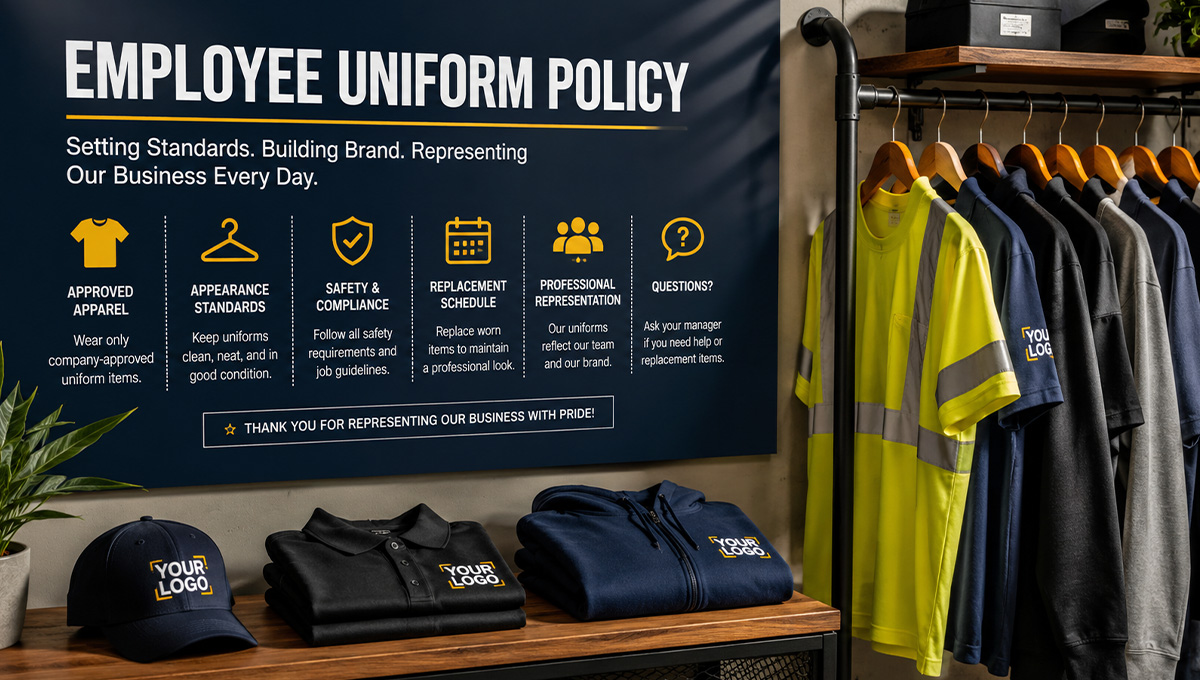
For many small businesses, branded apparel starts with a simple idea: “We need shirts with our logo.” But once your team grows, the real question becomes bigger than just choosing a polo, T-shirt, hoodie, or hat.
You need to know what employees are expected to wear, how often uniforms should be replaced, where the logo should go, who gets which items, and how to keep everyone looking consistent.
That is where an employee uniform policy for small business becomes useful.
A uniform policy does not have to be complicated. It simply gives your team clear guidelines for wearing company apparel while helping your business look more organized, professional, and trustworthy in front of customers.
Looking for a document you can customize for your own team? Download our free employee uniform policy template for small businesses, including uniform standards, care and replacement rules, accommodation language, employee acknowledgment, and apparel planning worksheets.
Why Small Businesses Need a Uniform Policy
When employees wear different shirts, faded apparel, mismatched colors, or inconsistent logo placement, it can make the business look less organized than it actually is. This matters even more for customer-facing industries like cleaning companies, contractors, HVAC businesses, pest control companies, landscaping crews, restaurants, retail shops, schools, and local service providers.
A clear small business uniform policy helps create consistency before employees ever show up to a job site, customer appointment, storefront, or event.
It helps answer questions like:
- What apparel is approved for work?
- Where should the company logo appear?
- How many shirts or uniforms should each employee receive?
- When should worn-out apparel be replaced?
- Are employees allowed to wear non-company apparel?
- Who is responsible for keeping uniforms clean and presentable?
The goal is not to over-complicate your business. The goal is to remove confusion and help your team represent your company the same way every day.
What Should Be Included in an Employee Uniform Policy?
A good employee uniform policy should be simple, practical, and easy for employees to understand. You do not need a long legal document to get started. For most small businesses, the policy can be a one-page guide included in your onboarding materials.
Here are the key areas to include.
1. Approved Uniform Items
Start by listing the exact apparel items employees are allowed or required to wear. This may include:
- Logo polo shirts
- Branded T-shirts
- Work hoodies or sweatshirts
- Embroidered jackets
- Company hats or caps
- Safety vests or outerwear when needed
For example, a cleaning company may require branded polo shirts and black pants, while a construction company may need durable work shirts, hoodies, high-visibility apparel, and outerwear for colder months.
If your team works in different environments, you may need more than one approved apparel option.
2. Logo Placement and Branding Standards
Your uniform policy should explain how your logo should appear on employee apparel. This helps avoid inconsistent branding across different orders.
Common logo placement options include:
- Left chest logo on polos, work shirts, and jackets
- Full back logo or company information on T-shirts and hoodies
- Sleeve logo, phone number, or service name
- Hat front embroidery
- Neck or back yoke logo placement for a subtle branded detail
For most businesses, the left chest logo is the most common and professional option. It works especially well on polos, button-downs, jackets, and work shirts. Larger back prints may be useful for service crews, delivery teams, construction companies, and event staff because they make the business more visible from a distance.
If you are unsure where your logo should go, you may also find this related guide helpful: Logo Placement Ideas for Custom Business Apparel.
3. Color Guidelines
Color consistency is one of the easiest ways to make uniforms look professional. If every employee is wearing a different shade of blue, gray, or black, the team may still look mismatched even when the logo is correct.
Your policy should define your approved apparel colors. For example:
- Black polo with white embroidered logo
- Navy work shirt with left chest logo
- Gray hoodie with front logo and back print
- High-visibility safety shirt for field crews
Keeping your color options limited makes future reorders easier and helps your brand stay recognizable.
4. When Employees Should Wear Company Apparel
Not every business needs employees in uniform every minute of the day. But your policy should clearly state when branded apparel is required.
Examples may include:
- During customer appointments
- While working at a job site
- At trade shows or community events
- During deliveries or installations
- When representing the company in public
This is especially important for service-based businesses where employees enter homes, offices, commercial buildings, schools, or job sites. Branded apparel helps customers quickly identify who is arriving and what company they represent.
5. Uniform Care and Appearance Standards
A logo shirt only helps your brand if it looks clean and presentable. Your uniform policy should explain that apparel should be worn in good condition and replaced when it becomes faded, stained, torn, or no longer professional.
You can keep this section simple:
- Uniforms should be clean at the start of each shift.
- Apparel should not be excessively faded, ripped, or stained.
- Employees should not alter the logo or design.
- Company apparel should be worn in a way that reflects the business professionally.
This protects your brand image without making the policy feel too strict or complicated.
6. Replacement Schedule
Small businesses often wait too long to replace employee apparel. By the time shirts look worn out, customers may have already noticed.
A simple replacement schedule helps prevent that.
As a general starting point, many businesses may want to review employee uniforms every 6 to 12 months, depending on how often the apparel is worn and the type of work being done.
For example:
- Office or retail polos may last longer with light wear.
- Construction and landscaping shirts may need replacement more often.
- Cleaning company uniforms may need backups due to frequent washing.
- Outerwear may last longer but should still be checked for logo condition and appearance.
It is better to plan for replacements ahead of time than to rush a reorder when half the team is wearing faded or inconsistent apparel.
How Many Uniform Pieces Should Each Employee Have?
The right number depends on the business, schedule, and type of work. But in most cases, one shirt is not enough.
A practical starting point for many small businesses is:
- 3 to 5 branded shirts per full-time employee
- 1 hoodie, sweatshirt, or jacket for cooler weather
- 1 to 2 hats if hats are part of the company look
- Extra pieces for new hires, replacements, and emergencies
If employees work outside, get dirty, or wash uniforms frequently, it is smart to order more pieces per person. If employees only wear branded apparel for events or customer meetings, fewer pieces may be enough.
The key is to think about real usage, not just the first order.
Choosing the Right Apparel for the Job
Your uniform policy should match how your employees actually work. A polo may look great in an office or showroom, but it may not be the best choice for every job site.
Here are a few examples:
- Cleaning companies: lightweight polos, performance shirts, aprons, or zip-up jackets.
- Contractors: durable T-shirts, long sleeves, hoodies, safety shirts, and work jackets.
- Restaurants: branded T-shirts, polos, aprons, and hats.
- Landscaping companies: breathable shirts, high-visibility colors, hoodies, and caps.
- Office teams: embroidered polos, quarter-zips, button-downs, or softshell jackets.
- Schools and organizations: polos, spirit wear, event shirts, staff jackets, and caps.
If your team works in warm weather, you may also want to read: Summer Employee Uniforms: Keeping Your Team Cool and Professional.
Embroidery, Printing, or Both?
Your uniform policy can also help define which decoration method should be used on different apparel items.
Embroidery is often a strong choice for polos, hats, jackets, quarter-zips, and higher-end business apparel. It gives the logo a professional, long-lasting appearance.
Printing may be a better fit for larger designs, full back graphics, event shirts, safety shirts, and T-shirts with more detailed artwork.
Some businesses use both. For example, a contractor may choose embroidered hats and left chest logos, but use a printed full back design on work shirts with the company name, phone number, and services.
If you are deciding between decoration methods, you may find this helpful: What Is DTF Printing? Complete Guide for Custom Business Apparel.
Who Pays for Employee Uniforms?
This is an important question, and the answer may depend on your business, state laws, industry, and whether the clothing is considered required workwear or safety-related apparel.
Many small businesses choose to provide a basic uniform package to employees, especially when the apparel carries the company logo and is required for work. Others may offer a uniform allowance, replacement schedule, or optional branded apparel store.
If your uniforms involve safety apparel, PPE, high-visibility requirements, flame-resistant clothing, or other job-specific protective gear, it is important to review applicable labor and safety rules before creating your policy.
When in doubt, speak with a qualified HR or legal professional so your policy fits your business and location.
Common Uniform Policy Mistakes to Avoid
A uniform policy should make life easier, not harder. Here are a few common mistakes small businesses should avoid.
Ordering Too Many Random Styles
Too many shirt colors, brands, and fits can make reordering difficult. It can also make the team look inconsistent. Choose a core set of approved apparel items and build around them.
Ignoring Seasonal Needs
A short-sleeve polo may work in spring, but your employees may need hoodies, jackets, long sleeves, or breathable summer shirts depending on the season.
Not Planning for New Hires
If you hire suddenly, you do not want to wait until the last minute to order branded apparel. Keep a few common sizes on hand when possible.
Using Poor Logo Placement
A logo that is too large, too small, too low, or placed in the wrong area can make good apparel look unprofessional. Standardize your logo placement before placing future orders.
Waiting Too Long to Replace Worn Apparel
Faded, stained, or damaged uniforms can hurt the professional image you are trying to build. Review uniforms regularly and plan replacement orders before they become urgent.
Sample Employee Uniform Policy for Small Business
Here is a simple example you can adjust for your own company:
Company Uniform Policy Example:
Employees are expected to wear approved company apparel when representing the business during work hours, customer appointments, job site visits, deliveries, events, or other company-related activities. Approved apparel may include logo shirts, polos, jackets, hats, or other branded items provided or approved by management. Uniforms should be clean, presentable, and worn in good condition. Apparel with excessive fading, stains, rips, or damage should be replaced. Employees should not alter the company logo, decoration, or approved uniform design without permission. Additional or replacement apparel may be ordered as needed based on role, season, and business requirements.
This does not need to be complicated. The purpose is to create consistency and give employees clear expectations.
Final Thoughts: A Good Uniform Policy Protects Your Brand
Custom apparel is not just about putting a logo on a shirt. For a small business, it is part of how customers recognize your company, judge your professionalism, and remember your brand.
A clear employee uniform policy helps your team look organized, makes reorders easier, and keeps your branding consistent as your business grows.
Whether you need embroidered polos, custom work shirts, branded hats, hoodies, jackets, or a full employee apparel program, Custom 2 Wear can help you choose apparel that fits your business, your team, and your brand.
Need help planning your company uniforms? Contact Custom 2 Wear to discuss branded apparel options for your team.
Frequently Asked Questions About Employee Uniform Policies
What is an employee uniform policy?
An employee uniform policy is a simple set of guidelines that explains what employees should wear while representing the company. It may include approved apparel, logo placement, colors, care instructions, replacement rules, and when uniforms are required.
Does a small business need a uniform policy?
Not every small business needs a formal policy, but having one helps create consistency. It is especially useful for customer-facing businesses such as contractors, cleaning companies, restaurants, retail shops, delivery teams, schools, and service providers.
How many uniform shirts should each employee have?
Many small businesses start with 3 to 5 branded shirts per full-time employee, plus seasonal items like hoodies, jackets, or hats when needed. The right number depends on how often the employee works, how dirty the job is, and how frequently uniforms need to be washed.
What should be included in a company uniform policy?
A company uniform policy should include approved apparel items, colors, logo placement, when uniforms must be worn, care expectations, replacement guidelines, and any rules around non-company apparel.
Should employee uniforms be embroidered or printed?
Embroidery is often best for polos, hats, jackets, and professional business apparel. Printing is often better for larger designs, full back artwork, T-shirts, event shirts, and work shirts with phone numbers or service information.
When should small businesses replace employee uniforms?
Uniforms should be replaced when they become faded, stained, damaged, or no longer represent the business professionally. Many businesses review uniforms every 6 to 12 months, depending on the type of work and how often the apparel is worn.