Ordering custom uniforms for your business should make your team look more professional, not create boxes of unused shirts in the wrong sizes.
But sizing is one of the easiest parts of a uniform order to underestimate. A business owner may know they need custom t-shirts, embroidered polos, hoodies, jackets, hats, or workwear, but the real challenge often comes right before placing the order:
How many smalls, mediums, larges, XLs, and 2XLs should you order?
Should you choose unisex sizing or women’s fit?
Should employees size up for hoodies or jackets?
How many extras should you keep on hand for new hires?
This employee uniform sizing guide will help you collect sizes the right way, avoid common ordering mistakes, and plan a smarter custom apparel order for your team.
Why Sizing Matters More With Custom Apparel
Custom apparel is different from buying blank shirts off a shelf. Once your company logo is embroidered or printed on the garment, the order is made specifically for your business.
That means sizing should be handled before production starts.
A good sizing plan helps you:
- Reduce wasted inventory
- Avoid unhappy employees
- Keep your team looking consistent
- Make reorders easier
- Prevent last-minute delays
- Order the right mix of shirts, polos, hoodies, jackets, and hats
Whether you are ordering custom logo t-shirts, embroidered polos, custom sweatshirts, or branded workwear, the sizing step should be part of your ordering process from the beginning.
Step 1: Decide What Each Employee Actually Needs
Before collecting sizes, decide what each employee should receive.
A small office team may only need embroidered polos. A construction crew may need work shirts, hoodies, jackets, and hats. A cleaning company, restaurant, school, gym, or field service business may need different pieces depending on the role.
Start with a simple uniform plan like this:
| Employee Role | Recommended Apparel |
|---|---|
| Front office | 2–3 embroidered polos |
| Field staff | 3–5 work shirts or t-shirts |
| Outdoor crew | Shirts, hoodies, jackets, hats |
| Managers | Polos, jackets, branded hats |
| Event staff | T-shirts, polos, or sweatshirts |
| New hires | Starter uniform pack |
This step matters because sizes may change depending on the garment. An employee may wear a large t-shirt but prefer an XL hoodie or jacket for layering.
For a more complete structure, review our guide on how to build a small business uniform program.
Step 2: Do Not Guess Employee Sizes
One of the biggest mistakes business owners make is guessing.
Even if you know your team well, guessing sizes usually leads to problems. Some employees prefer a relaxed fit. Others prefer a more fitted shirt. Some may need tall sizes, extended sizes, or women’s cuts.
The best approach is to collect sizes directly from each employee.
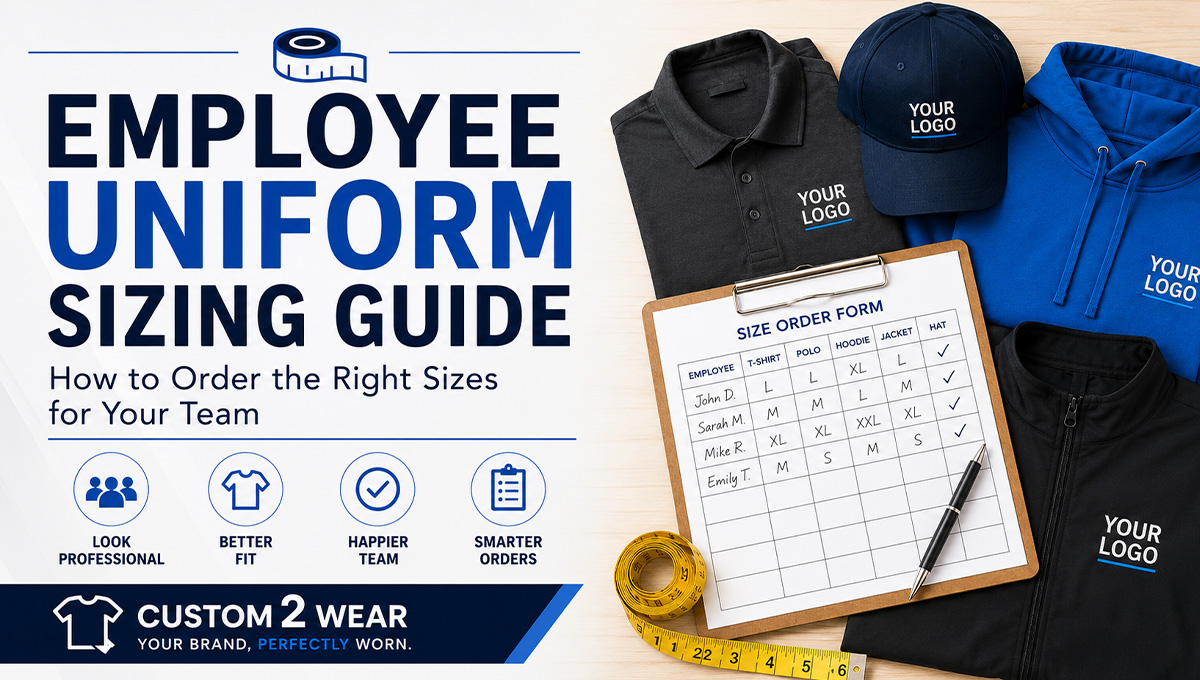
Use a simple employee uniform size order form like this:
| Employee Name | Role/Department | T-Shirt Size | Polo Size | Hoodie Size | Jacket Size | Preferred Fit | Notes |
|---|---|---|---|---|---|---|---|
| Relaxed / Standard / Fitted | |||||||
| Relaxed / Standard / Fitted |
Ask employees to submit the size they actually want to wear at work, not just the size they usually buy casually.
Step 3: Understand That Every Apparel Style Fits Differently
A medium is not always a medium across every product.
A basic t-shirt may fit differently than a performance polo. A hoodie may feel smaller once layered over another shirt. A work jacket may need extra room through the shoulders and arms.
T-Shirts
T-shirts are usually the easiest to size, but fabric, cut, and brand still matter. Some shirts are boxier. Others are softer, lighter, or more fitted.
For everyday staff shirts, many businesses choose custom logo t-shirts because they are affordable, comfortable, and easy to reorder.
Polos
Polos usually create a more professional look, especially for customer-facing teams. However, polos can fit differently in the chest, sleeves, and length compared to t-shirts.
For sales teams, office staff, restaurants, service businesses, and trade shows, custom embroidered polos are often the best choice.
Hoodies and Sweatshirts
Hoodies are often worn over another shirt, so many employees prefer a little extra room. If your team works in colder spaces, outdoors, warehouses, garages, or job sites, sizing up may be more comfortable.
Custom hoodies and sweatshirts are great for fall, winter, staff appreciation, and branded team apparel. Explore custom embroidered sweatshirts and hoodies if your team needs warmer branded apparel.
Jackets
Jackets require the most planning because employees may wear them over polos, t-shirts, or hoodies. Shoulder room and sleeve length matter more than they do with basic shirts.
For outdoor crews or mobile service teams, custom embroidered jackets can make the team look professional while adding practical value.
Hats
Hats are easier because many styles are adjustable, but the style still matters. Snapbacks, trucker hats, dad hats, and beanies all create a different look.
For field crews, events, giveaways, and everyday brand visibility, custom branded hats are one of the easiest uniform add-ons.
Step 4: Choose Between Unisex, Men’s, and Women’s Fits
Many business uniform orders use unisex sizing because it keeps ordering simple. That can work well for t-shirts, hoodies, and some workwear.
But for polos, fitted t-shirts, jackets, or customer-facing uniforms, offering women’s fit options can make a big difference.
| Fit Type | Best For |
|---|---|
| Unisex | Simple team orders, event shirts, hoodies, general staff apparel |
| Men’s fit | Polos, work shirts, jackets, standard business apparel |
| Women’s fit | Customer-facing uniforms, office teams, fitted polos, fitted tees |
| Tall sizes | Taller employees, jackets, long sleeve shirts, workwear |
| Extended sizes | Better comfort and professional fit for the full team |
The goal is not to overcomplicate the order. The goal is to make sure employees will actually wear the apparel comfortably.
Step 5: Use Product Size Charts Before Final Approval
Before approving a custom apparel order, compare the selected product to the size chart for that exact item.
Do not rely only on what employees usually wear. A large in one brand may not fit exactly like a large in another brand.
A good size chart usually includes measurements such as chest, body length, sleeve length, or garment width. When possible, compare those measurements to a shirt, polo, hoodie, or jacket the employee already likes wearing.
You can also review general apparel sizing guidance from trusted supplier resources such as SanMar’s size and fit guide, but the most important chart is always the one for the specific product being ordered.
Step 6: Order Samples for Larger or Ongoing Uniform Programs
For a one-time event, collecting employee sizes may be enough.
For a long-term uniform program, ordering samples can save money over time.
Samples are especially helpful when:
- You are ordering for 12+ employees
- You plan to reorder the same uniforms later
- Your team includes many different body types
- You are choosing between two apparel styles
- Employees will wear the uniforms daily
- You are ordering polos, jackets, or workwear
- You are building a branded uniform program for the first time
A sample set gives your team a chance to check the feel, fit, color, and overall look before placing a larger decorated order.
Step 7: Plan Extra Inventory for New Employees and Replacements
Do not order only the exact sizes submitted.
Most businesses should keep a few extra pieces on hand, especially in common sizes. This helps when you hire someone new, replace a damaged shirt, prepare for an event, or need a backup uniform quickly.
| Team Size | Suggested Extra Inventory |
|---|---|
| 5–10 employees | 2–4 extra pieces |
| 11–25 employees | 5–8 extra pieces |
| 26–50 employees | 8–15 extra pieces |
| 50+ employees | Plan by department and reorder schedule |
The most common extras are usually medium, large, XL, and 2XL, but your workforce may be different. If you have past orders, use that history to guide the next order.
Step 8: Think About Shrinkage, Layering, and Job Movement
Sizing is not only about standing still.
Employees move, bend, lift, reach, drive, clean, cook, install, repair, greet customers, and work in real environments. Uniforms should fit the job, not just the size chart.
Before placing the order, think about:
- Will employees wear shirts tucked or untucked?
- Will they layer hoodies over t-shirts?
- Will jackets go over polos or sweatshirts?
- Will the fabric shrink after washing?
- Will employees need room to move?
- Will the apparel be worn indoors, outdoors, or both?
- Will the team need short sleeve and long sleeve options?
For uniforms that will be washed often, it is also worth reviewing proper care instructions. Our guide on how to wash embroidered and printed work shirts explains how to help branded apparel last longer.
Step 9: Match Apparel Type to the Work Environment
The right size also depends on where the apparel will be worn.
A restaurant polo, warehouse hoodie, landscaping work shirt, office jacket, and event t-shirt all have different fit needs.
| Business Type | Sizing Consideration |
|---|---|
| Cleaning company | Comfortable movement, breathable shirts, easy washing |
| Construction company | Room for movement, layering, safety apparel |
| Restaurant | Polished fit, comfort during long shifts |
| Office team | Clean appearance, consistent sizing, polos or jackets |
| Trade show team | Professional fit, brand visibility, comfort for long days |
| Outdoor crew | Hoodies, jackets, hats, seasonal sizing |
| School or organization | Simple size collection, extras for late additions |
A uniform should make the team look consistent without making employees uncomfortable.
Step 10: Make Sizing Part of Your Uniform Policy
If uniforms are part of your business image, sizing should not be handled randomly each time you reorder.
Add a simple sizing process to your employee uniform policy. This can include:
- How employees submit sizes
- When sizes must be confirmed
- Whether employees may choose relaxed or standard fit
- Who approves replacement pieces
- What happens if an employee orders the wrong size
- How often uniforms are refreshed
- How new hires receive apparel
This keeps future orders easier and prevents confusion.
You can also download our employee uniform policy template if you want a more complete starting point.
Common Uniform Sizing Mistakes to Avoid
Mistake 1: Ordering Only One Apparel Style for Everyone
One product may not work for every role. Office staff, field staff, managers, and outdoor crews may need different garments.
Mistake 2: Not Offering Enough Size Range
A professional uniform program should account for the whole team. Make sure the selected apparel is available in the sizes your employees need before approving the order.
Mistake 3: Forgetting About Women’s Fit Options
Unisex sizing is convenient, but it may not be the best choice for every employee or every business.
Mistake 4: Ordering Too Few Extras
New hires, damaged shirts, and last-minute staffing changes happen. A small amount of extra inventory can prevent headaches later.
Mistake 5: Not Checking the Product Size Chart
Every apparel brand and style can fit differently. Always check the size chart for the exact product.
Mistake 6: Treating Hoodies and Jackets Like T-Shirts
Outerwear usually needs more room. Employees may need to size up for comfort and layering.
Mistake 7: Waiting Until the Last Minute
Sizing takes time, especially when multiple employees need to respond. Build sizing into your order timeline before production. If you are working around an event date, read our guide on how far in advance to order custom shirts.
Simple Employee Uniform Size Collection Form
Use this simple format before placing your next order:
| Employee Name | Department | T-Shirt | Polo | Hoodie | Jacket | Hat Style | Notes |
|---|---|---|---|---|---|---|---|
| S / M / L / XL / 2XL / 3XL | Snapback / Dad Hat / Beanie | ||||||
| S / M / L / XL / 2XL / 3XL | Snapback / Dad Hat / Beanie |
Helpful note to include with the form:
Please choose the size you would be comfortable wearing at work. If you are between sizes or prefer a relaxed fit, note that before the order is submitted.
Final Checklist Before Ordering Team Uniforms
Before approving your custom apparel order, confirm:
- Employee sizes have been collected
- Product size charts have been reviewed
- Apparel style matches the work environment
- Women’s, tall, or extended sizes are considered
- Hoodies and jackets allow room for layering
- Extra inventory is planned
- Logo placement is approved
- Artwork file is ready
- Production timeline is understood
- Final quantities are confirmed
A few extra minutes spent on sizing can save money, prevent frustration, and help your team look more professional from day one.
If you are not sure whether your logo file is ready for embroidery or printing, review our guide on what file type you need for custom embroidery or printing.
What About Returns If the Size Is Wrong?
Because custom-decorated apparel is made specifically for your business, sizing should be confirmed carefully before production. In most cases, embroidered, printed, or personalized items cannot simply be returned because the wrong size was chosen.
Before placing your order, review the product size chart, collect employee sizes in writing, confirm the final size breakdown, and read the Custom 2 Wear return policy so expectations are clear before production begins.
Need Help Planning a Custom Uniform Order?
Custom 2 Wear helps businesses order custom embroidered apparel, branded workwear, logo t-shirts, polos, hoodies, jackets, and hats with a clean, professional look.
Whether you are ordering for a small crew, a growing company, a school, an event, or a complete employee uniform program, we can help you choose apparel styles that fit your team, your brand, and your budget.
Request a custom apparel quote and tell us what you need, how many pieces you are considering, and what type of apparel your team will wear.
Frequently Asked Questions About Employee Uniform Sizing
What is the best way to collect employee uniform sizes?
The best way is to use a simple size order form that asks for each employee’s shirt, polo, hoodie, jacket, and hat preferences. Do not guess sizes for employees. Collect the information directly and confirm it before production.
Should I order extra uniforms for my business?
Yes. Most businesses should keep a few extra uniforms in common sizes for new hires, replacements, events, or damaged apparel. The right number depends on the size of the team and how often uniforms are used.
Are unisex shirts good for employee uniforms?
Unisex shirts work well for many team orders, especially t-shirts and hoodies. For polos, fitted shirts, jackets, or customer-facing uniforms, women’s fit options may create a better fit and more professional appearance.
Should employees size up for hoodies or jackets?
Often, yes. Hoodies and jackets are usually worn over another shirt, so many employees prefer extra room for comfort and layering. Job movement, fabric type, and season should also be considered.
Can custom uniforms be returned if the size is wrong?
Custom-decorated apparel is usually made specifically for the business, so sizes should be confirmed before production. Always review product size charts, collect employee sizes, and approve final quantities carefully.
How many uniforms should each employee receive?
The right number depends on the job and how often the employee works. Many full-time employees need at least three to five shirts so clean apparel is available between laundry days. Outdoor, physical, or dirty jobs may require additional pieces.
Should a business order samples before buying uniforms?
Samples are helpful for larger teams, ongoing uniform programs, or apparel that will be worn daily. A sample set allows employees to check fit, fabric, color, and comfort before the full decorated order is approved.