
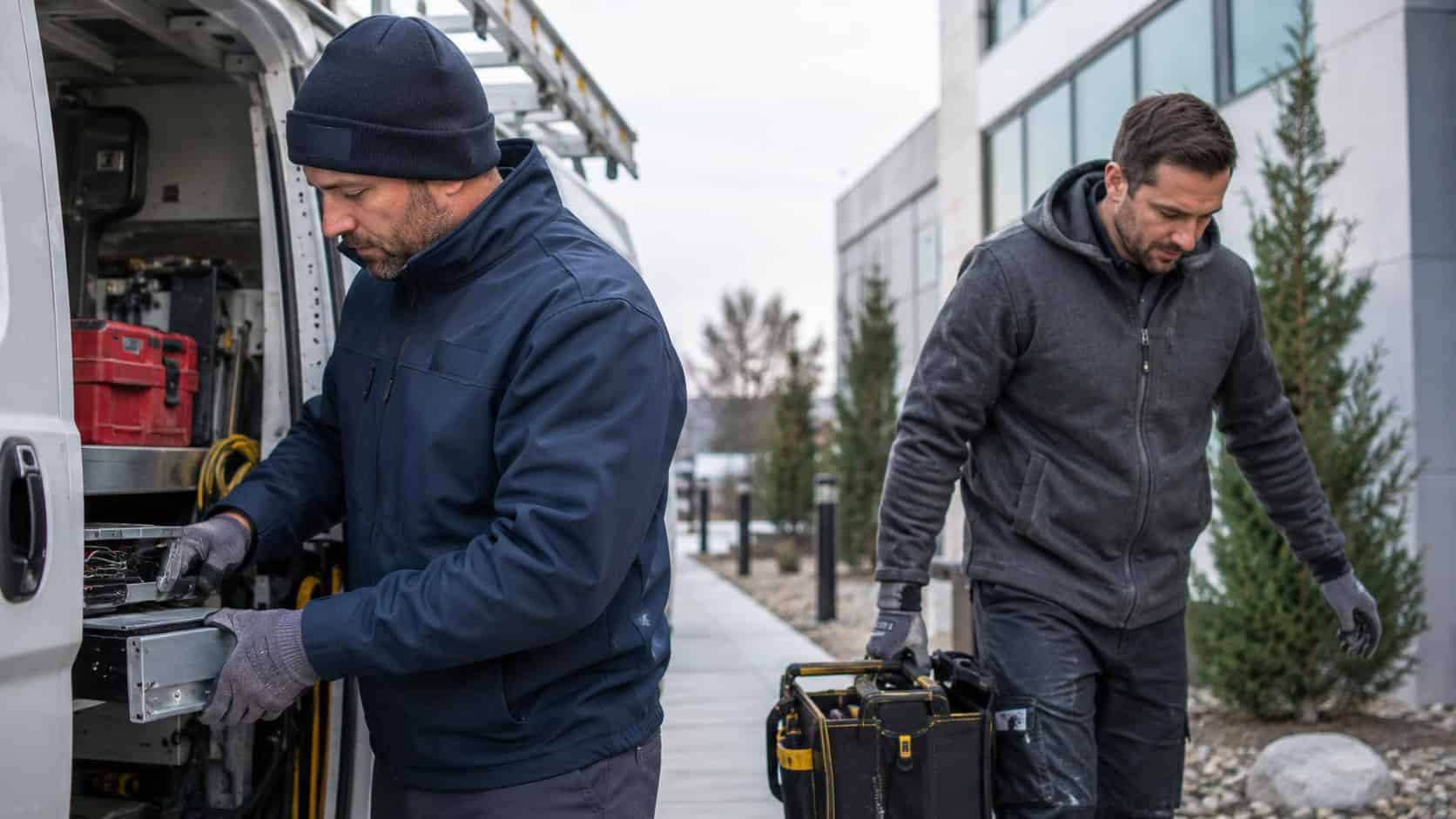
Cold-weather uniforms create a different purchasing problem than standard company polos or T-shirts. Once temperatures drop, employees start adding hoodies, jackets, coats, and hats—and if those layers are not planned as part of the uniform program, the company logo often disappears underneath them.
The better approach is to build a cold-weather work uniform system around the way employees actually work. A technician moving between a service van and customer buildings needs something different from a landscaping crew outdoors for hours. A sales representative may need a polished soft-shell jacket, while a warehouse or maintenance team may get more use from a durable branded hoodie.
This guide explains how businesses can choose branded hoodies, jackets, beanies, and other layers based on work environment, employee role, decoration method, sizing, weather exposure, and repeat-order needs.
Quick Answer: What Should Employees Wear for Cold-Weather Work?
For many businesses, the most practical cold-weather uniform is a coordinated layer system: a branded shirt or polo as the base uniform, a hoodie or fleece as an insulating everyday layer, and a soft-shell or weather-resistant jacket for employees who spend more time outdoors. An embroidered beanie can add another branded option for outdoor crews. Choose the garments around the job first, then select the decoration and logo placement that work with each garment.
Why Cold-Weather Uniform Planning Is Different
A summer uniform can often be built around one visible garment. Winter uniforms are more complicated because employees may add and remove layers repeatedly throughout the day.
That creates several purchasing decisions at once:
- Weather exposure: Is the employee outside for minutes at a time or working outdoors for much of the shift?
- Work intensity: Does the job involve constant physical movement or more stationary work?
- Indoor/outdoor transitions: Will employees repeatedly enter offices, homes, restaurants, vehicles, warehouses, or job trailers?
- Customer contact: Does the outer layer need to maintain a polished appearance during face-to-face interactions?
- Wet or windy conditions: Does the employee need something more protective than a standard sweatshirt?
- Uniform consistency: Will the company logo still be visible when employees cover their normal work shirt?
The goal is not simply to find the warmest garment. It is to choose layers that make sense for the employee’s actual workday while keeping the company’s appearance consistent.
Expert rule of thumb: Brand the layer customers are most likely to see. If your technicians spend half the winter wearing jackets over their embroidered polos, the jacket has effectively become part of the uniform.
Build a Cold-Weather Uniform in Layers
Layering gives employees more flexibility than trying to solve every condition with one heavy garment. OSHA cold-stress guidance recommends multiple loose-fitting layers, including a moisture-managing inner layer, an insulating middle layer, and an outer layer that protects against wind and rain while allowing ventilation. NIOSH also recommends several loose layers and protecting exposed areas when workers cannot avoid cold conditions.
For a business uniform program, those layers can translate into a practical apparel system.
1. Base Layer: The Everyday Company Shirt
The base layer is the garment employees would normally wear during milder weather: a company T-shirt, work shirt, or embroidered polo.
For customer-facing teams, this remains important because the jacket or hoodie may come off indoors. Keeping the base garment consistent means employees still look like part of the same organization regardless of which layer is visible.
If your company is still standardizing its core garments, the small-business uniform program guide explains how to create an approved apparel system rather than choosing unrelated shirts each time an order is placed.
2. Mid Layer: Hoodie, Sweatshirt, or Fleece
A branded hoodie is one of the most versatile cold-weather additions for field crews, warehouse employees, maintenance teams, contractors, schools, event staff, and other organizations where a relaxed workwear appearance is appropriate.
A midweight hoodie can handle everyday layering, while a heavier sweatshirt may make more sense for employees who routinely work in colder environments.
Best for: Technicians, warehouse teams, contractors, landscaping crews, maintenance employees, school staff, volunteers, and other active roles that benefit from an easy insulating layer.
Two current C2W options illustrate the difference:
- Custom Heavyweight Hoodie – Independent Trading Co. IND4000 is currently positioned for warmth, durability, company sweatshirts, and branded team apparel.
- Custom Logo Zip Up Hoodie – Independent Trading Co. SS4500Z provides a full-zip option that can be easier to add or remove as employees move between environments.
For a deeper look at this layer specifically, see why custom embroidered hoodies and sweaters work for professional teams.
3. Outer Layer: Soft Shell or Weather-Resistant Jacket
For employees who regularly work outdoors, travel between customer locations, or represent the company in public, a branded jacket can become the most visible part of the cold-weather uniform.
Soft-shell jackets are especially useful when the company wants an outer layer that still has a clean business appearance. The current Custom Soft Shell Jacket – Weatherproof 6500 Logo Outerwear is a wind- and water-resistant option positioned for branded business uniforms and outdoor wear.
For crews more likely to encounter wet conditions, the Custom Logo Rain Jacket – Vintage Waterproof Jacket with Hood is another current C2W option. Its product information describes it as a water-resistant jacket suitable for business and team branding.
Best for: Service technicians, supervisors, field sales teams, property-service employees, installers, delivery personnel, contractors, and other employees whose outer layer remains visible to customers.
4. Headwear: Branded Beanies for Outdoor Roles
Cold-weather headwear can be useful for employees who spend meaningful time outdoors, particularly when hats are already an accepted part of the company uniform.
The current Custom Embroidered Beanie – Yupoong Cuffed Knit Hat for Winter Branding is designed specifically around winter branding, logo embroidery, and company uniforms.
A beanie should complement the rest of the uniform rather than become an unrelated promotional item. Use the same approved logo treatment, brand colors, and general visual standards used on company polos and outerwear.
Ordering Tip: Do not choose the winter hat, hoodie, and jacket independently. Put the pieces next to one another before ordering and confirm that garment colors, logo colors, and decoration styles still look like one uniform program.
Hoodie vs. Soft-Shell Jacket vs. Rain Jacket vs. Beanie
| Uniform Piece | Main Strength | Watch For | Best For |
|---|---|---|---|
| Midweight hoodie | Flexible everyday layering | May be too casual for some client-facing roles | Warehouse, schools, events, active service teams |
| Heavyweight hoodie | More substantial insulating layer | Bulkier under another jacket | Contractors, maintenance, landscaping, outdoor crews |
| Soft-shell jacket | Professional outerwear with weather resistance | Fit must allow the intended layers underneath | Technicians, supervisors, sales and service teams |
| Rain jacket | Useful when wet conditions are part of the job | Decoration options depend on shell construction | Delivery, landscaping, maintenance, outdoor field work |
| Embroidered beanie | Adds branded cold-weather headwear | Not appropriate for every workplace or customer setting | Outdoor crews, contractors, events, field staff |
Choose Cold-Weather Work Uniforms by Employee Role
One of the most common uniform-planning mistakes is giving every employee the same outerwear simply because they work for the same company.
A better system starts with the employee’s role.
HVAC, Plumbing, Electrical, and Field-Service Teams
These employees may move from a service vehicle to outdoor equipment and then into a customer’s home or business several times per day.
A zip hoodie or soft-shell jacket can be especially practical because employees can adjust the layer without changing the entire uniform. For customer-facing technicians, a clean embroidered jacket also preserves the professional appearance of the uniform after the polo underneath is covered.
Construction and Landscaping Crews
Outdoor trade crews often need a more rugged combination. A heavyweight branded hoodie can work as an insulating layer, with appropriate outerwear added when conditions demand it.
Businesses building a larger workwear program can also use the existing construction company uniform guide and landscaping company uniform guide to coordinate shirts, workwear, branding, and job-specific needs across seasons.
For jobs involving actual cold-stress, high-visibility, flame-resistant, or other regulated workplace hazards, logo apparel should be selected within the company’s safety requirements and should not be assumed to replace required protective clothing or PPE.
Office, Sales, and Management Teams
A heavyweight pullover may be unnecessary for employees whose cold-weather exposure is primarily commuting, walking between buildings, visiting clients, or attending outdoor events.
A consistent soft-shell or other clean jacket can keep these employees aligned with the company uniform while working better with business-casual clothing.
Schools, Nonprofits, and Event Staff
Hoodies can be useful for staff working school arrival, dismissal, outdoor events, field trips, fundraising activities, or volunteer functions. A coordinated jacket or beanie can be added for employees and volunteers who spend longer periods outside.
The key is distinguishing staff apparel from merchandise: the uniform pieces should use controlled colors, approved logos, and repeatable placement so employees remain easy to recognize.
Restaurants and Hospitality Businesses
Cold-weather apparel may matter most for curbside service, deliveries, outdoor host stations, managers moving between locations, or employees handling exterior duties.
Rather than issuing bulky outerwear to everyone, consider which positions actually need an additional layer and whether the garment still fits the appearance standards of the business.
Building a Cold-Weather Uniform Package for Your Team?
Custom 2 Wear can help businesses compare hoodies, jackets, hats, decoration methods, and logo placement based on employee roles and the way the garments will actually be used.
Embroidery, DTF, or Screen Printing on Cold-Weather Apparel?
The garment should be selected before the decoration method. Outerwear introduces zippers, pockets, seams, linings, coatings, stretch, and other construction details that can affect where and how a logo can be applied.
Custom 2 Wear offers embroidery, DTF/DTG printing, screen printing, and specialty decoration options. The right method depends on the garment, artwork, quantity, placement, and the finished look the business needs.
Embroidery
Embroidery is often the strongest starting point for professional jackets, soft shells, polos, and knit headwear. It produces a dimensional stitched mark and works naturally with the professional appearance many businesses want from outerwear.
It is not simply a matter of moving the same logo file from a polo to a jacket. Fine lettering, narrow lines, logo dimensions, pockets, seams, and the available embroidery field can all affect the result.
If your logo contains small text or fine detail, review how small embroidery can be before detail becomes difficult to reproduce.
DTF and Full-Color Printing
DTF can be useful when the artwork contains multiple colors, gradients, or details that would be cumbersome to reproduce in thread. It can be especially useful on compatible sweatshirts and apparel surfaces.
However, technical outerwear should always be evaluated before assuming a heat-applied decoration is appropriate. Shell materials, coatings, seams, pockets, and heat sensitivity may limit decoration choices.
Screen Printing
Screen printing can make sense for branded hoodies and sweatshirts, particularly when a business wants a larger, bold graphic and is ordering enough garments for screen printing to be practical.
It is usually better to choose the garment and intended print area first rather than assuming the same screen-print treatment should be applied to every layer in the uniform.
For a broader comparison, see embroidery vs. screen printing for business apparel.
Decoration Note: Do not approve decoration based only on a blank garment photo. Confirm the actual placement area, pockets, seams, zipper position, lining, artwork size, and intended logo treatment before production.
Where Should the Company Logo Go on a Jacket or Hoodie?
For most business outerwear, the priority is simple: the logo needs to remain visible without overwhelming the garment.
Left Chest
Left-chest embroidery is a common choice for company jackets because it provides clear branding while maintaining a restrained professional appearance. Zippers, pockets, seams, linings, garment construction, artwork, and logo size can affect which placement areas are practical.
Best for: Technicians, sales staff, supervisors, office employees, managers, school staff, and customer-facing service teams.
Full Back
A larger back logo can make sense when visibility from a distance matters more than a subtle corporate appearance—for example, some outdoor crews, event teams, installers, or service employees working around vehicles and equipment.
That does not mean every jacket needs both a chest and back logo. Extra decoration should have a clear purpose.
Hoodies
Hoodies give businesses more flexibility. A small left-chest logo can match the rest of the company uniform, while a larger front or back treatment may work for less formal crews or event-oriented apparel.
Beanies
On cuffed knit beanies, the cuff naturally provides a compact branding area. Simple logos and readable shapes are usually easier to recognize than trying to reproduce a wide, highly detailed corporate mark at a small size.
The existing business apparel logo-placement guide can help companies create a consistent hierarchy across polos, work shirts, hoodies, jackets, sleeves, and other garments.
Do Not Forget Layering When Collecting Employee Sizes
Outerwear sizing should be evaluated based on how employees will actually wear the garment.
A jacket that fits perfectly over a T-shirt may feel very different over a polo and heavyweight hoodie. Likewise, automatically ordering jackets one size larger for everyone can create an unnecessarily loose fit for employees who use only a light base layer.
A better process is to:
- Decide what employees are expected to wear underneath the garment.
- Use the manufacturer’s size information for the selected product.
- Have employees evaluate fit with the intended layers whenever practical.
- Collect actual employee sizes rather than estimating from appearance.
- Keep the approved garment and size information organized for reorders and new hires.
For a more complete process, use the employee uniform sizing guide before placing the order.
How Many Cold Weather Uniform Pieces Should a Business Order?
The quantities do not need to be identical for every garment.
An employee may need several everyday base shirts because those garments are worn and laundered frequently, while the same employee may need fewer jackets. A field technician may need a hoodie and an outer jacket, while an office employee may need only the jacket.
Instead of building the order by garment alone, build it by role:
- What does this employee wear every day?
- What layer is needed only in colder weather?
- What garment stays on during customer interactions?
- How often will each piece need laundering or replacement?
- Which positions need weather-resistant outerwear?
- Which positions need headwear?
This approach makes it easier to control the uniform budget without giving employees garments they rarely use. The employee uniform cost guide provides additional guidance on budgeting an overall uniform program.
Standardize the Winter Uniform Before You Need Reorders
A good cold-weather program should be easy to reproduce next month or next season.
Document:
- approved garment names
- approved garment colors
- logo version and thread/print treatment
- decoration location
- employee size records
- which roles receive which garments
- replacement and new-hire ordering procedures
This prevents a common problem: the company places one winter order, then six months later nobody remembers which navy jacket, logo size, or embroidery location was approved.
If artwork needs to be prepared for different decoration methods, review C2W’s logo file guide for embroidery and printing and the current Artwork, Setup & Decoration Policy.
When Should Businesses Order Cold-Weather Uniforms?
Start before employees are already asking for jackets.
Cold-weather uniform ordering involves more than production itself. The business may need time to:
- decide which roles need each garment
- compare hoodie and jacket options
- collect employee sizes
- confirm colors and product availability
- prepare or adjust artwork
- approve logo placement and decoration
- receive and distribute the finished apparel
Planning earlier also gives the business time to test whether the selected layers work together instead of making a rushed purchase after the first major temperature drop.
Six Cold-Weather Uniform Mistakes to Avoid
1. Ordering the Same Outerwear for Every Employee
Uniform consistency does not require identical garments for every role. A service technician, office manager, outdoor crew member, and event volunteer may all need different layers while still sharing the same colors and branding system.
2. Buying for Warmth Without Considering the Job
The heaviest garment is not automatically the best garment. Mobility, weather exposure, customer contact, indoor/outdoor transitions, and the employee’s activity level matter.
3. Choosing Decoration Before Choosing the Garment
A logo location that works on a sweatshirt may be blocked by a pocket, seam, zipper, or lining on a jacket.
4. Ignoring the Layers Underneath
Outerwear should be sized around its real use. Have employees evaluate fit with the clothing they are expected to wear underneath.
5. Letting Employees Cover the Brand With Personal Outerwear
If employees routinely need a jacket for work, a company-approved outer layer can help preserve the uniform instead of leaving each employee to add an unrelated personal coat or sweatshirt.
6. Treating Branded Apparel as Safety Equipment
A company logo does not make a garment appropriate for every workplace hazard. Employers with cold-stress, high-visibility, flame, chemical, or other protective-clothing requirements should select garments according to the applicable safety program first, then determine how branding fits within those requirements.
Current Custom 2 Wear Options for a Cold-Weather Uniform Program
A cold-weather uniform does not need every available layer. A small number of standardized pieces is usually easier to manage and reorder.
Custom Soft Shell Jacket – Weatherproof 6500 Logo Outerwear
Best for: Customer-facing field employees, technicians, supervisors, corporate staff, and teams that need a professional outer layer with wind and water resistance.
Custom Heavyweight Hoodie – Independent Trading Co. IND4000
Best for: Contractors, service crews, maintenance teams, outdoor employees, and other roles that benefit from a more substantial branded sweatshirt.
Custom Logo Zip Up Hoodie – Independent Trading Co. SS4500Z
Best for: Employees who regularly adjust layers as they move between vehicles, indoor spaces, warehouses, job sites, or changing temperatures.
Custom Embroidered Beanie – Yupoong Cuffed Knit Hat for Winter Branding
Best for: Outdoor crews, contractors, field staff, events, and organizations where cold-weather headwear fits the uniform policy.
For companies that need several garment types, multiple logos, unusual decoration locations, personalization, or help deciding which products fit each role, the better next step is usually a project-level review rather than selecting garments independently.
Cold-Weather Work Uniform FAQs
What is the best cold-weather work uniform for employees?
The best cold-weather work uniform depends on the employee’s job and exposure. Many businesses can use a branded base shirt, a hoodie or fleece for an adjustable middle layer, and a soft-shell or weather-resistant jacket for employees who work outdoors or travel between locations. Outdoor crews may also benefit from company-approved cold-weather headwear.
Should company jackets be embroidered or printed?
Embroidery is a strong choice for many professional jackets because it provides a clean stitched appearance, but the best decoration depends on the garment construction, fabric, logo, placement, and desired design. Some artwork or garments may be better suited to another decoration method, so the jacket should be selected before the decoration is finalized.
Are hoodies professional enough for employee uniforms?
Yes, for many businesses and job roles. A clean, consistently branded hoodie can work well for contractors, technicians, warehouse teams, schools, maintenance staff, events, and other active workplaces. More formal customer-facing roles may be better served by a soft-shell jacket or other structured outerwear.
How should I size jackets for employees who wear layers?
Employees should evaluate the jacket with the type of clothing they are expected to wear underneath it. Do not automatically size every employee up. Use the selected garment’s sizing information, collect actual employee sizes, and test fit with the intended base or middle layers whenever practical.
Should every employee receive the same winter uniform pieces?
Not necessarily. Employees can share the same colors, logos, and overall uniform standards while receiving different garments based on their roles. An outdoor technician may need a hoodie and jacket, while an office employee may need only a jacket. Role-based ordering can make the uniform program more practical and easier to budget.
When should a business order cold-weather uniforms?
Order before employees actually need the cold-weather garments. Leave enough time to choose products, collect sizes, prepare artwork, confirm decoration placement, review availability, complete production, and distribute the apparel. Starting early also gives the business time to verify that jackets, hoodies, and base garments layer properly together.
Build a Cold-Weather Uniform Around the Way Your Team Works
The strongest winter uniform is not the one with the most garments. It is the one employees can use consistently across their actual jobs.
Start with each role, decide which layers employees genuinely need, keep the colors and logo treatment consistent, and make sure the program can be reordered for replacements and new hires. Custom 2 Wear can help compare apparel and decoration options for service crews, contractors, schools, offices, restaurants, organizations, and other business teams.
Request a Custom Apparel Quote Explore Custom Apparel Services