
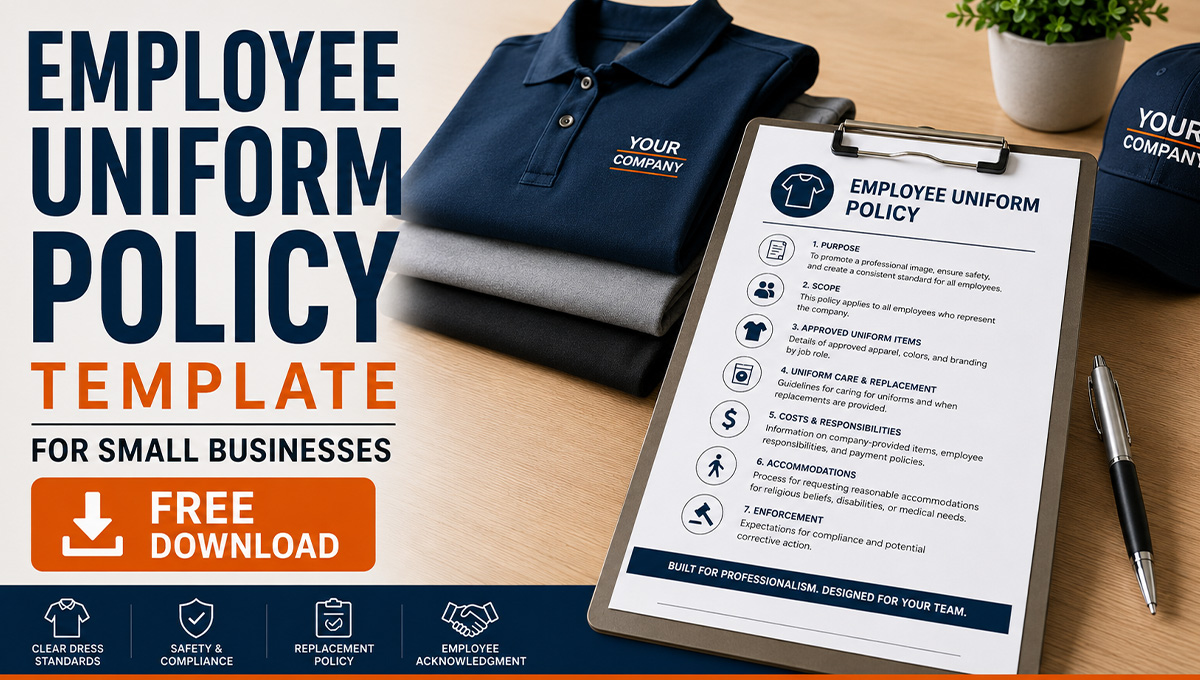
An employee uniform policy template gives small business owners a practical starting point for explaining what employees should wear, when company apparel is required, how uniforms should be maintained, and what happens when an item needs to be replaced.
Without a written policy, employees may receive different instructions from different managers. One person may wear an embroidered polo while another wears an old company T-shirt. Some employees may wear personal jackets over the company logo, while others may not know whether hats, hoodies, footwear, or outerwear are allowed.
A clear policy removes that uncertainty.
To make the process easier, Custom 2 Wear created a free, fillable PDF that small businesses can customize for their team.
Download the Free Employee Uniform Policy Template
Download the Free Employee Uniform Policy Template PDF
The downloadable template includes:
- Company and policy information
- Purpose and scope
- Approved uniform items by job role
- Rules for when company apparel must be worn
- Appearance, fit, color, and branding standards
- Personal layers, outerwear, and headwear
- Footwear, safety apparel, and PPE
- Grooming and hygiene expectations
- Uniform issuance, care, and replacement
- Uniform costs and payroll deductions
- Accommodation requests
- Policy enforcement
- Return of company property
- Employee acknowledgment
- Manager implementation checklist
- Uniform ordering and reorder worksheets
The document is fillable on a computer and can also be printed for handwritten completion.
Important: This employee uniform policy template is provided for general educational purposes and is not legal advice. Employment laws, wage rules, safety requirements, and uniform regulations may differ by state, municipality, industry, and job type. Have a qualified HR or legal professional review your completed policy before adopting it.
What Is an Employee Uniform Policy Template?
An employee uniform policy template is a customizable document that explains a company’s expectations for uniforms, branded apparel, footwear, grooming, safety clothing, and overall workplace appearance.
Instead of writing a policy from scratch, the employer begins with a structured document and adapts it to the company’s actual needs.
A useful template should answer questions such as:
- Which employees are covered?
- What clothing is required or permitted?
- When must uniforms be worn?
- Which colors and garment styles are approved?
- Where should the company logo appear?
- Who provides and pays for the uniforms?
- Who is responsible for washing them?
- When will worn or damaged apparel be replaced?
- Are employees permitted to wear personal jackets or hats?
- How can an employee request an accommodation?
- What happens when the policy is not followed?
For a broader discussion of these decisions, read our guide to creating an employee uniform policy for a small business.
Why Small Businesses Need a Written Uniform Policy
A small business may be able to manage employee clothing informally when it has only one or two workers. As the team grows, verbal instructions become harder to apply consistently.
Employees may be unsure whether a certain shirt, jacket, hat, or pair of shoes is acceptable. Managers may enforce standards differently. New hires may receive less apparel than existing employees. Replacement orders may be placed only after uniforms are visibly worn out.
A written policy helps establish one standard for everyone.
It creates a consistent company appearance
Customers should be able to recognize employees quickly, particularly when workers enter homes, visit offices, make deliveries, perform installations, or work at customer locations.
Approved colors, garments, and logo placements help the team look coordinated rather than assembled from unrelated apparel orders.
It makes employee onboarding easier
New employees can receive the policy along with their uniform package. They immediately know what they are expected to wear, how to care for each item, and who to contact with questions.
It makes replacement decisions more objective
The policy can explain when uniforms will be replaced because of ordinary wear, work-related damage, size changes, or seasonal requirements.
That prevents managers from making replacement decisions differently for each employee.
It makes apparel reordering easier
Once the company has documented its approved garment style numbers, colors, logo files, decoration methods, and placement specifications, future orders no longer need to be recreated from memory.
Our guide to building a simple small business uniform program explains how to standardize these details across new hires, departments, and future reorders.
How to Customize the Employee Uniform Policy Template
The free PDF contains editable fields and checkboxes, but each employer should adapt the document to its own workplace.
The following sections deserve particular attention.
1. Define Who the Policy Covers
Begin by stating which workers, departments, or positions must follow the policy.
The same requirements may not be appropriate for every employee. A field technician, office employee, delivery driver, sales representative, and warehouse worker may each need a different uniform package.
The policy might apply to:
- All employees
- Customer-facing employees
- Field crews
- Delivery or installation teams
- Managers and supervisors
- Event staff
- Employees assigned to specific facilities
- Temporary or seasonal workers
Defining the scope prevents employees from assuming that rules apply only to certain people.
2. State When Uniforms Must Be Worn
Explain exactly when company apparel is required.
Examples include:
- During every scheduled shift
- While visiting customer homes or businesses
- At active job sites
- During deliveries or installations
- At trade shows and community events
- While operating a company vehicle
- When appearing in company photographs or videos
- Whenever an employee publicly represents the business
Some businesses may permit a more relaxed dress standard when employees are completing administrative work away from customers. Others may require approved apparel throughout the entire workday.
Write the rule that matches the way your company operates.
3. List Approved Uniform Items by Role
Avoid vague language such as “wear a company shirt.”
Identify the actual garments employees may or must wear. This can include:
- Embroidered polo shirts
- Printed work T-shirts
- Button-down shirts
- Performance shirts
- Hoodies or crewneck sweatshirts
- Quarter-zips
- Work jackets
- Softshell jackets
- Company hats
- Safety shirts or vests
- Aprons
- Approved pants or shorts
The downloadable template includes a role-based chart where you can record the garment, color, quantity, and any special notes for each department.
For example:
Field crew: Four printed work shirts, one hoodie, one embroidered hat, and one approved work jacket.
Supervisors: Three embroidered polos, two work shirts, one quarter-zip, one jacket, and one embroidered hat.
Office staff: Three embroidered polos and one softshell jacket.
This approach allows every employee to receive clothing appropriate for the work being performed.
Free Employee Uniform Policy Template
Download the fillable and printable PDF to create clear uniform, dress code, safety, replacement, and accommodation standards for your small business.
4. Establish Color, Fit, and Appearance Standards
A logo alone does not make a team look consistent. Garment color, fit, condition, and styling also matter.
The policy should identify:
- Approved company colors
- Approved pants or bottoms
- Whether shirts must be tucked in
- Whether personal undershirts may be visible
- Whether employees may alter sleeves, collars, or hems
- Whether personal pins, patches, or slogans are permitted
- When faded, stained, torn, or damaged apparel must be replaced
Use objective language whenever possible. “Clean, properly fitted, and free from excessive damage” is clearer and easier to enforce than simply requiring employees to “look professional.”
5. Standardize Logo Placement and Decoration
A written uniform policy can also protect the company’s visual identity.
Document where the logo should appear on each garment and which decoration method should be used.
Common standards include:
- Left-chest embroidery on polos, jackets, and quarter-zips
- Front embroidery on company hats
- Small left-chest print on work shirts
- Larger company logo or contact information on the back
- Department name or employee name on the right chest
- Secondary branding on a sleeve
Our logo placement guide for custom business apparel provides examples for shirt fronts, backs, sleeves, neck areas, hoodies, jackets, and hats.
You should also preserve the production details used for approved apparel, including:
- Garment brand and style number
- Garment color
- Logo file used
- Embroidery thread colors
- Print colors
- Decoration width and height
- Exact placement
- Employee-name format
Before placing an order, review the logo file types needed for custom embroidery and printing.
6. Address Personal Layers, Outerwear, and Hats
One of the most common uniform problems occurs when employees cover approved company apparel with an unbranded personal hoodie, coat, or jacket.
Your policy should explain whether employees may wear personal layers and under what conditions.
Possible rules include:
- Solid-color undershirts may be worn beneath company apparel.
- Only company-approved outerwear may be worn during customer appointments.
- Personal coats may be worn outdoors during extreme weather.
- Hats are permitted only for designated positions.
- Headwear must be company-issued or approved by management.
- Apparel displaying unrelated businesses, slogans, graphics, or political messages may not be worn while representing the company.
Businesses that use hats as part of their uniform can review our comparison of custom hats for business.
7. Separate Ordinary Uniforms From Safety Apparel and PPE
A branded work shirt and required personal protective equipment do not serve the same purpose.
Ordinary uniform apparel may help identify employees and present the brand consistently. PPE is selected to protect workers from specific workplace hazards.
Your policy should identify any required items such as:
- High-visibility apparel
- Safety glasses
- Gloves
- Hearing protection
- Hard hats
- Safety-toe footwear
- Respiratory protection
- Protective coveralls
- Flame-resistant clothing
The company should separately document who provides, inspects, replaces, cleans, and trains employees to use required PPE.
The Occupational Safety and Health Administration explains that employers generally must provide and pay for required PPE, although specific exceptions apply. Review the current OSHA guidance on payment for personal protective equipment when developing this section.
8. Explain Uniform Care and Replacement
Employees should know who is responsible for routine washing and what to do when an item is damaged.
The policy can address:
- Routine laundering
- Special cleaning requirements
- Stain removal
- Storage of uniforms
- Reporting damage
- Normal wear and tear
- Work-related damage
- Lost apparel
- Size changes
- Seasonal replacements
- Expected replacement intervals
Do not rely only on an annual replacement date. A damaged or badly stained shirt may need to be removed from use immediately, while a lightly worn jacket may remain presentable for several years.
Businesses with employees working in hot environments should also consider seasonal garments. Our guide to breathable work shirts with a logo explains options for outdoor and active teams.
9. Clarify Who Pays for Required Uniforms
Uniform cost policies deserve careful review.
Under the federal Fair Labor Standards Act, requiring an employee to bear uniform costs cannot reduce the employee’s pay below the applicable minimum wage or reduce required overtime compensation. State and local laws may provide additional restrictions.
Review the U.S. Department of Labor’s Fact Sheet #16 on wage deductions for uniforms and have your final payment or deduction policy reviewed for the locations where your employees work.
Common approaches include:
- Providing a standard uniform package at no cost
- Providing an annual uniform allowance
- Replacing items damaged through ordinary work
- Allowing employees to purchase optional extra apparel
- Requiring written authorization before any lawful deduction
- Prohibiting managers from making informal paycheck deductions
Avoid adding automatic deductions for lost, damaged, or unreturned apparel without first confirming that the deduction is lawful.
10. Include an Accommodation Process
A good uniform dress code policy needs a clear way for employees to request an exception or reasonable accommodation.
An employee may need a modification because of:
- A sincerely held religious practice
- A disability or medical condition
- Pregnancy, childbirth, or a related medical limitation
- Another protected reason under applicable law
The Equal Employment Opportunity Commission explains that an employer may need to modify a dress or grooming rule for a religious practice or disability unless doing so would create an applicable undue hardship. The EEOC’s prohibited employment practices guidance provides additional information.
Covered employers should also review the Pregnant Workers Fairness Act guidance when a uniform, fit, footwear, heat, or safety requirement conflicts with a pregnancy-related limitation.
The policy should identify:
- Who receives accommodation requests
- How employees may submit a request
- How requests will be reviewed
- How temporary arrangements are handled
- That retaliation for requesting an accommodation is prohibited
Avoid requiring employees to disclose sensitive medical or religious information directly to a front-line supervisor when another confidential process is available.
11. Describe Enforcement Without Making the Policy Unnecessarily Harsh
A uniform policy should establish expectations, not create avoidable conflict.
Managers should first confirm that:
- The employee received the policy
- The rule was explained clearly
- The employee received or could obtain the required apparel
- The uniform still fits properly
- The employee is not waiting for a replacement
- The employee does not need an accommodation
Corrective action should be consistent with the company handbook and applied evenly across comparable positions.
A typical process may begin with a reminder or coaching conversation before moving to formal corrective action for repeated or intentional violations.
12. Explain What Happens When Employment Ends
Some apparel may become the employee’s property, while other items may need to be returned.
Examples of returnable property can include:
- Security-identifying outerwear
- Expensive work jackets
- Specialized protective equipment
- Access badges
- Tools or devices
- Apparel displaying restricted credentials
- Rental or company-owned garments
Identify these items in advance rather than deciding after the employee leaves.
Any proposed deduction for unreturned property should be reviewed for compliance with applicable wage laws.
Sample Employee Uniform Policy Language
The downloadable PDF provides a much more complete policy, but the following paragraph can serve as a simple starting point:
Employees are expected to wear approved company apparel whenever they are performing scheduled work, meeting customers, visiting job sites, making deliveries, attending company events, or otherwise representing the business. Uniforms must be clean, properly fitted, and free from excessive stains, fading, holes, or damage. Employees may not alter or cover the approved company logo without authorization. Questions, replacement requests, and accommodation requests should be directed to the designated company contact.
A complete policy should expand this language to address the company’s actual garments, roles, safety requirements, payment practices, and accommodation procedures.
Turn the Policy Into a Repeatable Uniform Program
Writing the policy is only the first step. The next goal is to make the apparel program easy to manage.
For each approved garment, record:
- Product brand
- Style number
- Color
- Available size range
- Decoration method
- Logo placement
- Thread or print colors
- Decoration dimensions
- Original artwork file
- Typical production time
- Reorder quantity
The planning worksheets included in the free employee uniform policy template provide space for this information.
When the details are standardized, the business can outfit new employees and place replacement orders without choosing new shirts, colors, or decoration layouts every time.
When deciding which garments should be embroidered and which should be printed, review our comparison of embroidery and screen printing for business apparel.
How to Introduce the Policy to Employees
Do not simply place the document in a handbook and assume everyone understands it.
Use a straightforward rollout:
- Explain why the policy is being introduced.
- Show employees the approved garments.
- Review when each item should be worn.
- Explain how to request replacements.
- Identify the accommodation contact.
- Give employees time to ask questions.
- Collect a signed acknowledgment.
- Keep the policy available for future reference.
Managers should receive the same information so the policy is enforced consistently across departments and shifts.
Need Branded Uniforms That Match Your New Policy?
Once your standards are documented, Custom 2 Wear can help turn them into a consistent apparel program.
We provide custom embroidery and printing for:
- Employee polos
- Work shirts
- Performance shirts
- Hoodies and sweatshirts
- Jackets and outerwear
- Company hats
- Safety apparel
- Department and employee-name personalization
We can help standardize garment colors, logo placement, decoration size, embroidery thread colors, print details, and repeat-order specifications.
Explore our custom apparel and decoration services or request a quote for your employee uniform program.
Frequently Asked Questions About Employee Uniform Policies
What is an employee uniform policy template?
An employee uniform policy template is a customizable document that explains which garments employees should wear, when uniforms are required, how apparel should be maintained, who pays for it, how replacements are handled, and how employees can request an exception or accommodation.
Does a small business need a written uniform policy?
A written policy is not necessary for every workplace, but it is helpful when employees wear branded apparel, work with customers, visit job sites, use safety clothing, or receive company-provided uniforms. It creates consistent expectations for employees and managers.
What should be included in an employee uniform policy?
The policy should address who is covered, approved apparel, required colors, logo placement, when uniforms must be worn, appearance and care standards, footwear, safety apparel, replacements, costs, accommodations, enforcement, and return of company property.
Can an employer charge employees for required uniforms?
Federal law restricts uniform costs and deductions when they would reduce an employee’s wages below the required minimum wage or cut into overtime compensation. State and local laws may impose additional restrictions. Employers should have their specific policy reviewed before charging employees or making payroll deductions.
How many uniform shirts should each employee receive?
The right number depends on the employee’s schedule and work environment. Many full-time employees need at least three to five shirts so clean apparel is available between laundry days. Employees performing dirty, physical, or outdoor work may require additional pieces.
Can an employee request an exception to a uniform policy?
Yes. An employee may be entitled to a reasonable accommodation because of religion, disability, pregnancy, childbirth, a related medical condition, or another protected reason. The policy should identify a clear and confidential request process.
Is a company uniform the same as PPE?
No. A standard logo shirt or embroidered polo is usually intended for identification and branding. PPE is intended to protect an employee from a workplace hazard. Required PPE should be selected, provided, maintained, and managed according to applicable safety rules.
How often should an employee uniform policy be reviewed?
Review the policy at least once each year and whenever job duties, apparel styles, safety requirements, laws, work locations, or company branding change. The uniform inventory and replacement process should be reviewed at the same time.
Free Employee Uniform Policy Template
Download the fillable and printable PDF to create clear uniform, dress code, safety, replacement, and accommodation standards for your small business.