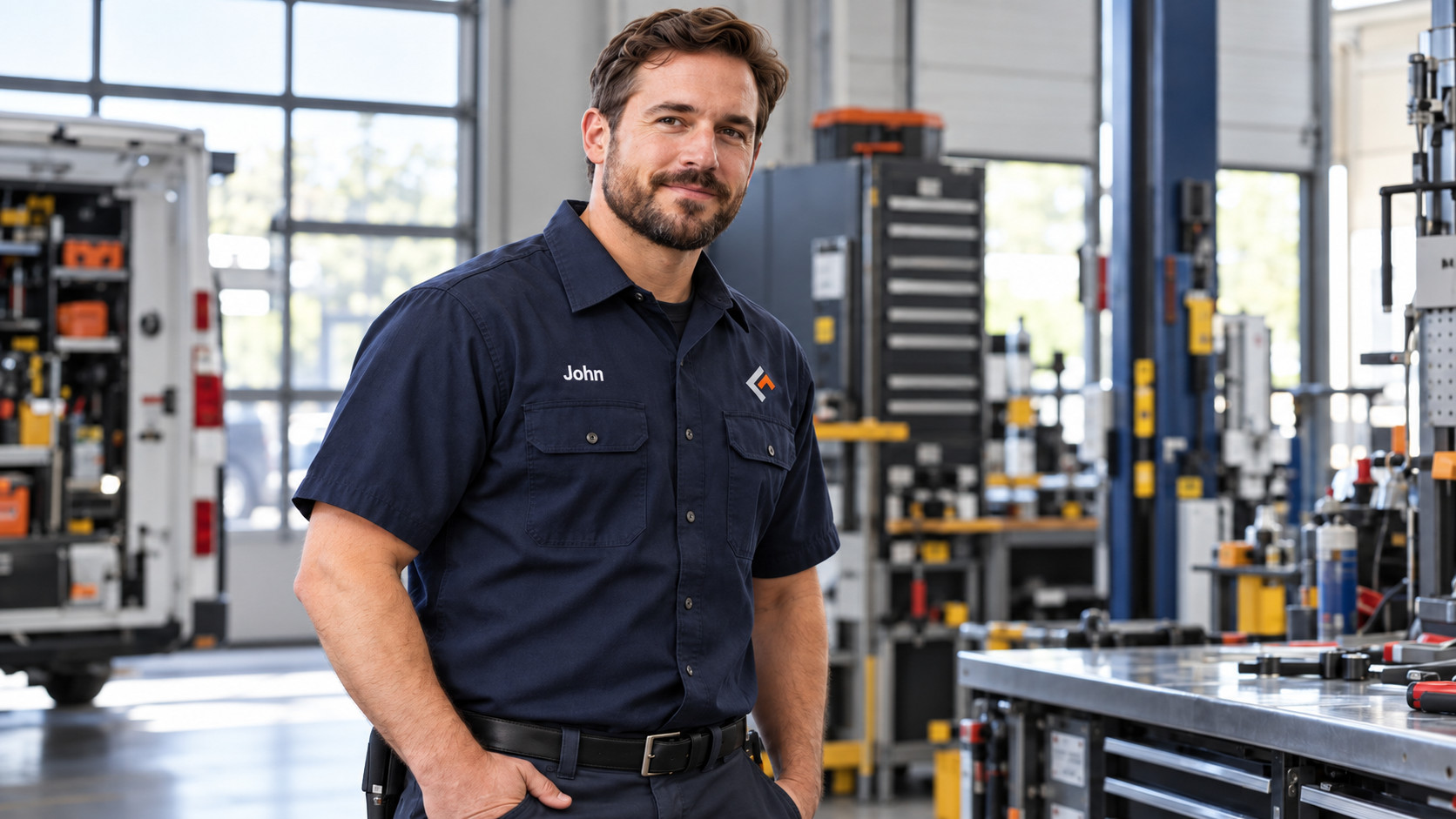
Custom work shirts with employee names help customers identify the people representing your business while giving employees a consistent, professional appearance. For HVAC technicians, plumbers, maintenance crews, cleaning teams, restaurant employees, and other service businesses, a company logo paired with an individual name can make everyday uniforms more useful.
But personalized work shirts require more planning than placing the same company logo on every garment. You need to choose a suitable decoration method, decide where names and logos belong, verify spelling, match names to sizes, and plan for future employees.
This guide explains how to build a practical, repeatable uniform order without adding unnecessary complexity.
Quick Answer: What’s the Best Way to Add Employee Names to Company Work Shirts?
For many collared work shirts and polos, an embroidered company logo on one chest and an employee’s first name on the opposite chest is a practical starting point. Embroidery provides a professional stitched appearance, while simple lettering helps keep names readable. Printed names can also work well, especially on lightweight T-shirts or where larger lettering is needed.
The best choice depends on the garment material, lettering size, order quantity, budget, and working conditions. Confirm the final layout and decoration method before ordering.
Should Your Business Put Employee Names on Work Shirts?
Adding individual names is useful when employees interact directly with customers or work in locations where identification matters. A plumbing technician entering a customer’s home may benefit from a readable first name alongside the company’s logo. The same applies to maintenance employees serving multiple properties or staff members working in a restaurant or service facility.
- Easier introductions: Customers can address employees by name.
- Clearer identification: Managers, customers, and coworkers can distinguish employees in similar uniforms.
- Consistent presentation: Every employee follows the same branding and personalization guidelines.
- Organized purchasing: Names, sizes, garment styles, and replacement orders can be tracked together.
Names are not necessary on every uniform. A warehouse crew with limited public interaction may only need a company logo. A restaurant may prefer first names instead of full names, while a contractor might choose a job title or department instead.
Best for: Service technicians, customer-facing teams, maintenance employees, and businesses that value individual identification.
Purchasing principle: Add employee names because they serve a business purpose—not simply because personalization is available.
Embroidered Names vs. Printed Names: Which Is Better?
Embroidery and printing can both work for personalized employee uniforms. The right method depends on the garment and the final appearance you want.
Embroidered Employee Names
Embroidery forms lettering with thread stitched into the garment. It is a strong option for polo shirts, traditional work shirts, and professional uniforms where a smaller chest-level name is appropriate.
Advantages:
- Professional stitched appearance
- Well suited to simple names and compact chest decoration
- Suitable for many conventional uniform fabrics
- Can coordinate with an embroidered company logo
Considerations: Very small lettering may become difficult to read; long names need sufficient width; heavy stitching can affect lightweight or stretchy fabric; and multiple names require careful individual production preparation.
Embroidery quality depends on font choice, thread, stitch construction, fabric stability, and lettering dimensions. Manufacturer embroidery design guidance from Melco explains why lettering size, stroke width, and spacing affect legibility. For more, see our embroidery lettering and minimum text size guide.
Printed Employee Names
Printing creates the name using a decoration process rather than stitches. Depending on the project, heat-applied transfers or other printing methods may be appropriate for different employee names. Direct-to-film (DTF) printing can be useful for certain personalized designs, especially when a business also wants full-color artwork.
Advantages:
- Flexible lettering and design appearance
- No stitched texture on the inside of the garment
- Potentially suitable for lightweight shirts and larger designs
- Useful when coordinating names with printed company graphics
Considerations: Fabric, finish, and heat tolerance affect suitability; tiny lettering may not reproduce or adhere reliably; improper laundering or heat exposure can shorten print life; and pricing depends on the process and artwork.
Traditional screen printing is generally better suited to designs repeated across multiple garments, rather than changing every employee’s name.
Embroidery vs. Printing Comparison
| Factor | Embroidered Names | Printed Names |
|---|---|---|
| Appearance | Stitched and textured | Smooth or raised, depending on method |
| Common garments | Polos, woven work shirts | T-shirts and suitable polos or work shirts |
| Small lettering | Needs careful digitizing and adequate size | Needs suitable print detail and dimensions |
| Individual names | Name-by-name preparation | Variable-name production workflow |
| Durability | Depends on stitching, fabric, care | Depends on process, application, care |
| Best use | Professional small chest names | Lightweight apparel or larger lettering |
Best for embroidery: Collared service uniforms and polos with simple employee names. Best for printing: Appropriate lightweight garments or projects where names coordinate with a larger printed design. Neither method is universally better.
Where Should the Company Logo and Employee Name Go?
The most common starting point for a personalized work shirt is to separate the company logo and employee name across the upper chest. This keeps both elements visible without making either compete for space.
Option 1: Company Logo on Left Chest, Employee Name on Right Chest
This is a practical layout for technicians, tradespeople, maintenance workers, and service companies. The logo identifies the business, while the name identifies the employee. It usually works well with collared shirts with open chest areas.
Best for: HVAC companies, plumbers, electricians, maintenance crews, and field service staff.
Option 2: Company Logo Above the Employee Name
Placing the name beneath the logo can work when one chest area is unavailable. The combined design needs sufficient vertical space and readable spacing, especially on pocketed shirts or styles with unusual seams.
Best for: Simple branding systems with short names and compact logos.
Option 3: Company Logo on Front, Larger Name or Role on Back
Some organizations need employee names, departments, or roles visible from a distance. Event support staff might use a company logo on the front and a larger printed role designation on the back.
Best for: Event teams, supervisors, and support crews needing more visible identification.
Placement Considerations by Garment
| Garment | Starting layout | Watch for |
|---|---|---|
| Button-front work shirt | Opposite-chest logo and name | Pockets, seams, placket |
| Polo shirt | Opposite-chest logo and name | Knit stability, seams |
| Performance polo | Small approved chest decoration | Stretch and heat sensitivity |
| T-shirt | Chest logo and name where suitable | Light fabric and drape |
| Jacket or hoodie | Front logo and name if space permits | Zippers, pockets, lining |
These are planning recommendations rather than guaranteed production placements. Review size and location for the exact garment. See our logo placement guide for business apparel.
Decoration Tip: Don’t Position Names by Guesswork
Shirt seams, pockets, zippers, and garment sizes change the usable decoration space. Approve a consistent placement standard for each garment style, and review longer names against the available width before production.
How Large Should Embroidered Employee Names Be?
Employee names need to be readable at a comfortable conversational distance. Letter height, font, thread thickness, spacing, and fabric all matter. A simple block-style font is usually easier to produce consistently than thin decorative lettering.
As a practical starting point, some commercial embroidery providers recommend lettering around 1/4 inch tall or larger. Melco’s embroidery guidelines note that this is a guideline, not a universal minimum; successful results depend on letter construction and fabric, and certain applications require larger lettering.
Handling Long Employee Names
An employee named Christopher and another named AJ have very different lettering widths. Define a maximum name area and decide what happens when a name exceeds it:
- Use an approved shortened first name.
- Adjust the layout after a proof review.
- Choose a different approved font or layout.
- Consider two lines when appropriate.
Do not squeeze every name to the same width or use an unapproved nickname. The employee or authorized purchaser should confirm the final display name.
Best Work Shirt Styles for Employee Name Personalization
Choose shirts for the working conditions first, then confirm decoration compatibility. Garment selection affects comfort, presentation, decoration quality, and future replacement orders.
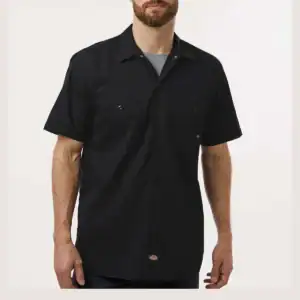
1. Industrial Work Shirts for Field Technicians
Traditional button-front work shirts suit inspections, repairs, installations, and maintenance. One current option is the Custom Dickies S535 Work Shirt, made from 4.25 oz., 65/35 polyester-cotton permanent-press poplin.
The current catalog listing describes printed company-logo customization. Confirm any individual-name embroidery or printing separately; do not assume it is included.
Best for: Service technicians, maintenance departments, repair companies, and traditional workwear programs.
2. Embroidered Polos for Customer-Facing Staff
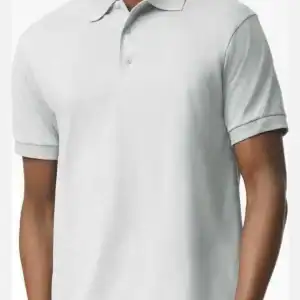
Polos provide a professional, less formal option for customer service staff, estimators, supervisors, and office employees. The Gildan DryBlend 8800 embroidered polo offers a polyester-cotton blend for a familiar collared uniform.
Best for: Office support teams, counter staff, and customer-facing service employees.
3. Performance Polos for Active Employees
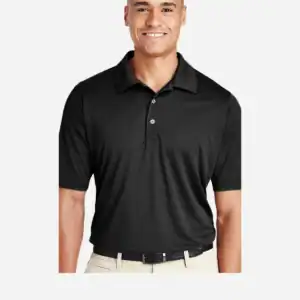
The Team 365 TT51 Performance Polo uses lightweight polyester interlock fabric. It may suit employees who move frequently or alternate between indoor and outdoor duties. Confirm name-decoration compatibility for the selected garment and placement.
Best for: Mobile service teams, supervisors, and active customer-facing staff.
Before Selecting a Garment
- Confirm fit and size availability for the whole team.
- Check fabric suitability for the work environment.
- Review decoration method and placement compatibility.
- Choose a manageable uniform color system.
- Check care requirements and replacement availability.
Current Workwear and Polo Options
These current C2W catalog garments provide starting points for a uniform program. The products are live and in stock, but individual name personalization and any extra charges must be confirmed for the complete project. Explore more custom workwear and custom embroidered polos.
-
Custom Team 365 TT51 Performance Polo Shirt – Performance Company Polo to Pinterest (opens in a new window)Price range: $19.95 through $30.95 Select options This product has options that may be chosen on the product page
-
Custom Embroidered Polo Shirt – Gildan DryBlend® 50/50 Blend Jersey Polo 8800 to Pinterest (opens in a new window)Price range: $20.95 through $28.95 Select options This product has options that may be chosen on the product page
What Affects the Cost of Personalized Employee Work Shirts?
Personalized work shirt pricing generally includes the garment and applicable decoration work. Different names introduce variables that do not exist when every garment has identical artwork.
Main Cost Factors
- Garment selection: Industrial work shirts, standard polos, and performance polos have different base costs.
- Decoration locations: A logo on one chest and a name on the other are two decorated areas.
- Decoration method: Embroidery pricing can depend on the design and stitch requirements; printing costs depend on process, size, and preparation.
- Individual variations: Multiple names require accurate records and production handling.
- Artwork preparation: Complex logos may need preparation or simplification.
- Replacements: A later single-shirt order may be priced differently than an initial team order.
Example: A Ten-Person Service Company
A plumbing company outfitting ten employees buys three shirts per person, each with the same company logo and the employee’s first name. That is thirty shirts but ten different name variations. The quote request should specify the shirt and sizes, thirty garments, ten exact names, both decoration locations, and any relevant artwork or personalization requirements.
That provides enough information to assess the whole project rather than treating it as thirty identical logo-only shirts. For budgeting help, read How Much Do Employee Uniforms Cost?
Planning a Personalized Uniform Order?
If your team needs different names on shirts featuring the same company logo, provide garment styles, employee count, name list, quantities, and desired placement so the full project can be reviewed.
How to Prepare an Employee Name, Size, and Quantity List
One of the most preventable mistakes is submitting a name list that does not clearly match each employee’s garments. An incorrect name or size may leave an otherwise good uniform unusable for its intended employee.
Example Employee Uniform Order Sheet
| Employee | Name to Decorate | Garment | Size | Color | Qty |
|---|---|---|---|---|---|
| Christopher Adams | Chris | Work shirt | L | Navy | 3 |
| Maria Lopez | Maria | Work shirt | M | Navy | 3 |
| Jordan Smith | Jordan | Polo | XL | Black | 2 |
| Alexis Taylor | Alex | Polo | S | Black | 2 |
Example only; all names and quantities are illustrative. For production orders, also record the garment identifier, decoration method, logo and name placement, and special instructions.
Use a Simple Approval Process
- Choose the garment and color: Define the styles for each role.
- Collect sizes: Use the specific manufacturer’s size chart, not assumptions across brands. See our employee uniform sizing guide.
- Confirm names: Check exact spelling, capitalization, and approved display names.
- Match names to garments: Record size, style, color, and quantity on one consolidated list.
- Approve decoration: Confirm font, location, logo, and thread or print colors.
- Check the final order: Assign one responsible reviewer before production.
Ordering Tip: Use One Final Approved List
Avoid spreading name changes across multiple messages after submission. Maintain one current document and confirm any later changes have been accepted before production.
How Many Personalized Shirts Should You Order Per Employee?
Names change how businesses should think about spare inventory. A generic company-logo shirt can be reassigned to anyone wearing the same size; a named shirt is less flexible.
Plan around scheduled workdays, laundry frequency, dirt or moisture exposure, replacement rates, seasonal duties, employee turnover, and spare garments. A five-day field technician may need more shirts than someone working two shifts weekly. Non-personalized backup shirts can reduce unused name-specific inventory. See the uniform quantity planning guide.
Managing New Hires, Replacements, and Repeat Orders
Personalized uniforms work best when the initial order creates a repeatable specification. If an HVAC company hires three technicians six months later, saved records help avoid mismatched shirt styles, name fonts, or logo placement.
Retain:
- Approved company logo files
- Garment manufacturer, style number, and color
- Decoration method and placement
- Name font and lettering specifications
- Approved thread or print colors
- Employee name, size, and quantity records
- Previous order references
What About Employee Turnover?
Personalized shirts are less flexible than logo-only garments. For roles with frequent turnover, consider named primary polos for long-term customer-facing staff, logo-only spares for temporary replacements, or role labels where individual names are unnecessary. Balance presentation with operating cost.
Common Mistakes to Avoid When Ordering Work Shirts With Names
- Choosing garments without checking decoration suitability: Fabric, seams, and pockets can limit placement.
- Making names too small: A readable digital mockup does not guarantee readable thread lettering.
- Using inconsistent names or fonts: Approve a naming standard first.
- Assuming personalization is included: Confirm extra decoration and name variation requirements in the quote.
- Skipping size verification: Named garments cannot easily be reassigned.
- Failing to save specifications: Repeat orders may otherwise look inconsistent.
For decoration options and artwork guidance, explore Custom 2 Wear’s embroidery and printing services.
Frequently Asked Questions
Can you put an employee name and company logo on the same work shirt?
Yes. Many business uniform layouts place the company logo on one chest and the employee name on the opposite chest. Final placement depends on garment construction, available decoration space, and the selected embroidery or printing process.
Is embroidery better than printing for employee names?
Embroidery is often a good choice for simple names on collared work shirts and polos. Printing can be suitable for lightweight shirts or larger lettering. The best method depends on the fabric, desired appearance, lettering size, care requirements, and production details.
Should employee work shirts display first names or full names?
First names are often a practical choice for customer-facing service uniforms because they are easier to fit and read. Full names, job titles, or role identifiers may be appropriate for some organizations. Employers should consider employee preferences, privacy, and workplace identification requirements.
Does adding different employee names increase the cost of uniforms?
It can. Individual names introduce personalization work beyond decorating every shirt with identical artwork. Pricing depends on the garment, decoration method, quantity, name variations, artwork requirements, and other production considerations. Request an itemized quote for the complete order.
How should a business order personalized work shirts for new employees?
Keep a record of the original garment style, color, logo placement, decoration method, and name lettering specifications. For each new employee, confirm the approved display name, garment size, and quantity before requesting a matching order.
Build a Uniform Program That Is Easy to Maintain
The best custom work shirts with employee names do more than display a logo and a first name. They establish a repeatable system for how your team looks, how uniforms are ordered, and how replacements are managed.
Start with a shirt that suits the job. Choose decoration that works with the material. Keep names readable, verify employee information, and save the specifications for future orders.
Custom 2 Wear works with businesses and organizations ordering decorated apparel for different team sizes and roles. If your company needs work shirts, embroidered polos, or employee uniforms with logo and name personalization, review the complete project requirements.
Ready to Plan Personalized Uniforms for Your Team?
Include your company logo, preferred garments, approximate quantities, employee-name requirements, and desired decoration locations so the project can be evaluated accurately.