
Contractors and field-service companies often need work shirts that accomplish two jobs: help employees remain visible in hazardous work environments and display a recognizable company logo.
But ordering custom hi vis shirts with logo decoration requires more care than choosing an ordinary promotional T-shirt. The garment’s safety classification, reflective material, logo placement, fabric, and jobsite conditions all affect the purchasing decision.
A road-construction crew may need compliant high-visibility safety apparel, while a landscaping company may want highly visible branded shirts for general field use. Those are not necessarily the same requirements.
This guide explains how to choose the right shirts, compare decoration options, and organize an efficient team order without overlooking important safety considerations.
Quick Answer: Can You Put a Company Logo on Hi-Vis Shirts?
Yes. High-visibility shirts can be customized with company logos, provided the decoration is suitable for the garment and does not compromise the safety features or compliance requirements that apply to the finished apparel.
For safety-rated garments, confirm the original classification, review the manufacturer’s decoration guidance, and avoid obstructing reflective material, compliance labels, or required visible background areas.
Best starting point: Select the work shirt for its safety requirements first. Plan the company branding second.
1. What Makes a Work Shirt High-Visibility?
High-visibility apparel is designed to make workers more conspicuous in environments where being noticed by drivers or equipment operators is important.
A bright-colored shirt and a compliant high-visibility safety garment are not automatically interchangeable. Three features deserve attention.
Fluorescent background material
Fluorescent yellow-green and fluorescent orange-red are commonly used in safety apparel because they increase conspicuity in appropriate lighting conditions. However, garment color alone does not establish an ANSI/ISEA safety classification.
Retroreflective material
Retroreflective trim returns light toward its source, helping make a wearer visible when illuminated by headlights or other light sources. Safety-rated shirts may incorporate reflective bands around the torso, shoulders, or sleeves. The reflective configuration and material coverage must be evaluated as part of the garment’s overall design.
Documented performance classification
ANSI/ISEA 107 establishes requirements for high-visibility safety apparel, including material performance, design, labeling, and garment classification.
A purchasing manager should look for an appropriate garment label and current manufacturer documentation rather than relying solely on the words “safety shirt” or “hi-vis” in an online listing.
Important distinction: A fluorescent company T-shirt may be useful for employee identification but should not be substituted for required high-visibility personal protective equipment without evidence that it satisfies applicable requirements.
For a broader approach to field-crew clothing, see our construction company uniform guide.
2. Understanding ANSI/ISEA 107 Safety Classes Before Ordering
The ANSI/ISEA 107-2020 standard classifies high-visibility safety apparel according to its intended use and performance characteristics. For business buyers, two terms are especially important: Type and Performance Class.
Common high-visibility garment types
| Garment type | General application | Purchasing consideration |
|---|---|---|
| Type O | Off-road occupational settings | Consider for applicable off-road environments after assessing hazards |
| Type R | Roadway and temporary traffic-control environments | Important for crews working near roadway traffic and construction vehicles |
| Type P | Public safety activities | Intended for applicable emergency and public safety roles |
What do performance classes mean?
Performance classes are based on the visible material areas and design requirements specified by the standard. Class 1, Class 2, and Class 3 are not simply marketing descriptions of shirt brightness.
For example, higher performance classifications have more demanding visible-material and design requirements. Class 2 is common in many roadway-related safety-apparel applications, while Class 3 provides additional conspicuity and may be required for certain higher-exposure situations.
The correct selection depends on work activities, hazards, relevant regulations, applicable traffic-control requirements, and employer safety procedures. A particular class should never be chosen solely because an apparel supplier offers it.
For reference, consult the ANSI/ISEA 107-2020 high-visibility safety apparel standard and OSHA’s guidance on high-visibility garments in highway work zones.
3. Short-Sleeve vs. Long-Sleeve Custom Hi-Vis Work Shirts
One of the first practical decisions is choosing the garment style. The best choice depends on weather, employee duties, exposure requirements, and the specific certified garment configuration.
| Consideration | Short-sleeve hi-vis shirt | Long-sleeve hi-vis shirt |
|---|---|---|
| Warm-weather use | Often preferred for less arm coverage | May feel warmer depending on fabric |
| Arm coverage | Leaves forearms exposed | Provides additional coverage |
| Outdoor crews | Practical for many summer operations | Useful for variable conditions |
| Branding space | Depends on pockets and reflective trim | Additional sleeve area does not guarantee printable space |
| Safety classification | Must be verified by garment | Must be verified by garment |
| Layering | Convenient under approved outer layers | Can serve as a longer-coverage base garment |
When short sleeves make sense
Short-sleeve high-visibility work shirts may be a practical choice for crews working outdoors in warm conditions. Breathable polyester performance fabrics can help manage moisture, although comfort also depends on garment fit, workload, humidity, and any required protective equipment.
Best for: Summer construction operations, landscape maintenance, utility support, and field crews whose safety requirements permit the selected shirt.
When long sleeves make sense
Long-sleeve options provide additional arm coverage and may be preferable for employees who work in changing temperatures or want more coverage during outdoor shifts. They are not automatically better for every hazardous environment. A long-sleeve polyester shirt should not be assumed to provide flame-resistant, arc-rated, chemical, or cut protection.
Best for: Outdoor maintenance teams, utility support personnel, and crews whose work procedures call for longer coverage.
Purchasing tip: Before standardizing on one garment, have employees test the actual fit and movement of a representative sample with their other required equipment.
4. Where Should a Company Logo Go on a Hi-Vis Shirt?
Logo placement is one of the most important differences between ordering ordinary company shirts and decorated safety apparel. On a standard T-shirt, the main question may be which placement looks best. On high-visibility safety apparel, placement must also account for the garment’s existing reflective layout, fluorescent material, labels, and any manufacturer restrictions.
Left-chest logo
A small left-chest logo often provides a professional appearance without overwhelming the shirt. However, chest pockets, seams, reflective bands, and limited decoration zones can restrict placement. A standard left-chest position is not necessarily appropriate for every safety shirt.
Upper-back logo
An upper-back logo can make employees easier to identify from behind. But the upper back may contain reflective material or required fluorescent background areas. Large back prints deserve particular scrutiny. Artwork that appears attractive in a mockup might occupy too much safety-critical space.
Sleeve logo
Sleeve decoration may be attractive for crew identification or a secondary brand mark. On safety apparel, reflective bands or garment construction may leave little usable area. A manufacturer-approved decoration zone should determine whether sleeve branding is suitable.
| Logo placement | Branding advantage | What to verify |
|---|---|---|
| Left chest | Professional, recognizable branding | Pocket, trim, available space |
| Upper back | Company identity from behind | Reflective layout and minimum visible material |
| Sleeve | Secondary logo or department mark | Reflective bands and garment construction |
| Large front print | Prominent company identity | Available compliant decoration area and print suitability |
Expert Recommendation: Do not select a safety-apparel logo position using an ordinary T-shirt mockup. Start with the exact garment style, map the reflective material and approved decoration areas, and review the finished design before production. A smaller logo in a suitable location is often preferable to a larger graphic that creates safety or production concerns.
For general apparel design principles, see our guide to logo placement on shirts. High-visibility apparel still requires an additional garment-specific review.
5. Which Decoration Method Works Best for Hi-Vis Safety Shirts?
Custom 2 Wear offers embroidery, full-color printing, and screen-printing services for branded business apparel. However, not every decoration process or location is appropriate for every safety garment. The correct method depends on the garment’s construction, fabric, decoration area, artwork, and manufacturer limitations.
DTF and full-color printing
Direct-to-film (DTF) printing can reproduce detailed, multicolor designs on many compatible garments. It may be worth evaluating for polyester work shirts when a suitable print location is available. However, transfer temperature, pressure, material compatibility, and covered surface area must be assessed before production. A DTF transfer should never be applied over reflective material or in a way that compromises required safety performance.
Best for: Detailed or multicolor logos on compatible shirts with an approved decoration location.
Screen printing
Screen printing can be a good option for consistent artwork across a larger uniform order. For high-visibility garments, the print process still requires evaluation of ink, substrate, placement, and the finished garment’s safety requirements. A large one-color design is not automatically acceptable simply because it is inexpensive or easy to reproduce.
Best for: Repeated designs and organized larger orders where the garment and print location are suitable.
Embroidery
Embroidery creates a professional stitched appearance and is commonly used on polos, jackets, hats, and many workwear garments. On lightweight performance shirts, stitching can introduce puckering, weight, or distortion. Puncturing specialized material or stitching near reflective components may also be inappropriate.
Best for: Compatible workwear garments with a suitable embroidery area and an approved decoration approach.
Decoration comparison
| Method | Potential advantage | Main consideration on hi-vis apparel |
|---|---|---|
| DTF printing | Detailed full-color graphics | Heat, pressure, transfer coverage, fabric compatibility |
| Screen printing | Consistent designs across larger runs | Ink, decoration area, print coverage |
| Embroidery | Durable stitched branding on suitable garments | Fabric stability, needle penetration, reflective elements |
Decoration Note: There is no universally approved printing or embroidery method for all ANSI-rated apparel. For compliant garments, obtain the relevant manufacturer guidance and confirm that the finished decorated garment remains suitable for the employer’s intended use.
Learn more about Custom 2 Wear’s embroidery and printing services and review the artwork, setup, and decoration policy before ordering.
Need Branded Hi-Vis Apparel for a Work Crew?
Send Custom 2 Wear your preferred garment styles, logo artwork, employee quantities, and required safety classification. We can review the available apparel and decoration options and identify issues that should be resolved before production.
6. Choosing Custom Hi-Vis Shirts for Different Industries
The same shirt will not necessarily suit every contractor or work environment. A purchasing manager should begin with the actual employee role rather than assuming all outdoor teams have identical apparel requirements.
Road construction and traffic-control crews
These workers may face exposure to moving vehicles, roadway traffic, and construction equipment. The required visibility classification and compliance with relevant work-zone procedures should be established before ordering.
Best for: Safety-rated garments selected according to applicable requirements, with decoration reviewed against the original garment specifications.
Landscaping and grounds-maintenance companies
Landscaping employees may work near parking lots, equipment, customer driveways, and public spaces. Some tasks may warrant certified high-visibility apparel; others may use brightly colored uniforms primarily for easy identification.
Best for: A role-specific uniform program that distinguishes safety PPE from general branded workwear.
Utility and electrical contractors
These crews may face multiple hazards, including traffic exposure and electrical risks. A high-visibility shirt should not be assumed to provide flame resistance or arc-flash protection. Where multiple protective properties are required, buyers need documentation showing that the selected garment meets each applicable requirement.
For additional uniform-planning considerations, read our electrician uniform guide.
Property maintenance and field-service teams
Maintenance workers may move between outdoor facilities, parking areas, warehouses, and customer locations. A practical program could include different shirts or layers according to the assignment.
Best for: Consistent company identification across role-appropriate garments, with compliant safety apparel used wherever required.
7. Current Custom 2 Wear Hi-Vis Work Shirt Options
Custom 2 Wear offers high-visibility garments in its Custom Workwear category. Two current options are particularly relevant to teams considering customized safety shirts.
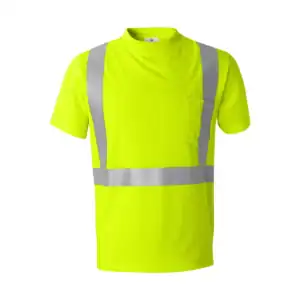
Kishigo 9110–9111 High Visibility Safety Shirt
This short-sleeve style is made from 4 oz./yd², 100% polyester birdseye fabric and includes moisture-management properties. The current product listing identifies:
- Lime and orange supplier color options
- Sizes S–5XL, subject to color-size availability
- A left-chest pocket
- Two-inch reflective material
- ANSI/ISEA 107 Type R, Class 2 classification as listed on the product page
It is a candidate for businesses needing a short-sleeve, roadway-oriented high-visibility shirt, provided the final selected configuration and decoration meet applicable requirements.
View the Kishigo 9110–9111 short-sleeve safety shirt
Best for: Crews needing a documented Type R, Class 2 short-sleeve option with company branding reviewed before production.
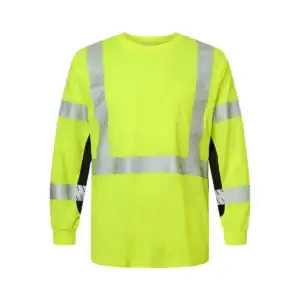
Kishigo 9134–9135 High Visibility Long Sleeve Shirt
This long-sleeve option uses 4.13 oz./yd², 100% polyester birdseye fabric. The current catalog lists three supplier color options and sizes M–5XL, with specific availability dependent on the selected variant.
Long sleeves can be useful for employees who need additional coverage or prefer that style of everyday workwear. The precise safety classification and permitted logo decoration positions should be confirmed against manufacturer documentation and the selected product configuration before the garment is approved for a particular jobsite.
View the Kishigo 9134–9135 long-sleeve safety shirt
Best for: Teams seeking a long-sleeve high-visibility work shirt, subject to confirmation of its suitability for the intended hazards.
Compare Current Work Shirt Options
The following products are available in the Custom 2 Wear B2B catalog:
-
Custom High Visibility Safety Long Sleeve Shirt – Kishigo 9134-9135 to Pinterest (opens in a new window)Price range: $63.95 through $65.95 Select options This product has options that may be chosen on the product page
Additional safety vests, high-visibility hoodies, and other garments are available in the broader Custom Workwear category.
Ordering reminder: Online in-stock status does not guarantee every color and size is available. Check individual variations and confirm decoration requirements before ordering.
8. How Many Custom Hi-Vis Shirts Should You Order?
Quantity planning matters because high-visibility work shirts may need more frequent cleaning or replacement than office apparel. The exact requirements depend on working conditions, garment-care instructions, and the employer’s uniform program.
Consider five factors.
- Days worked per week: A full-time outdoor employee typically needs enough garments to rotate between shifts and laundry cycles.
- Soiling and wear: Dust, grease, paint, and abrasion can affect the appearance and potentially the performance of safety apparel.
- Laundry schedules: Employees need clean, serviceable garments available when reporting to work.
- Size coverage: Confirm the required size distribution rather than purchasing equal quantities of each size.
- Replacement inventory: Keep appropriately classified spare garments available for new hires, damaged shirts, and emergency replacements.
Example: A 12-person maintenance crew
Suppose a maintenance company is planning three shirts per employee.
| Planning item | Quantity |
|---|---|
| Employees | 12 |
| Initial shirts per employee | 3 |
| Initial allocation | 36 |
| Extra replacement shirts | 6 |
| Total planned order | 42 |
This is an illustrative quantity plan, not a prescribed minimum. For a hazardous work environment, replacement timing must account for loss of visibility, damaged reflective components, and the manufacturer’s service-life and care instructions—not just whether the garment is clean enough to wear.
Our employee uniform quantity guide explains how to build a practical apparel allocation for different work schedules.
9. Preparing Logo Artwork for a Smooth Order
A clear artwork submission helps prevent unnecessary design revisions, especially when decoration space is limited. Before requesting a quote or starting an online order, gather the following information.
Company logo
Provide the cleanest available source file. Vector artwork is helpful for scalable print preparation, but a high-quality raster file may also be usable depending on the decoration method. Small text, thin outlines, gradients, and complex designs should be checked at the proposed finished size.
Desired logo dimensions
Specify approximate logo width or the intended appearance. Do not assume a standard chest-logo measurement will work across every high-visibility garment.
Garment details
Identify the exact garment model, preferred color, and required size range. If the safety classification matters, include it explicitly in the order requirements.
Employee quantities
Provide a size-by-size breakdown, including spare inventory where appropriate.
Previous artwork
If Custom 2 Wear already has your approved artwork, provide the previous order number or artwork reference when available.
10. Caring for Printed and Branded Hi-Vis Work Shirts
High-visibility apparel requires attention to both the garment and its safety-related components. Decorated shirts add another consideration: the print or embroidery must remain serviceable through normal use and approved care.
Follow the garment manufacturer’s instructions
Different safety garments may have specific washing, drying, and maximum-cleaning-cycle guidance. Do not substitute generic custom T-shirt care instructions for the manufacturer’s directions on a safety-rated garment.
Inspect reflective components
Check for significant damage, peeling, contamination, deterioration, or other conditions that could reduce visibility. Garments that no longer meet the employer’s safety requirements should be removed from service.
Check company logos
Printed graphics can crack or peel, while embroidered designs may experience thread damage. Assess whether the decoration affects the garment’s appearance, usability, or required safety features.
Establish a replacement procedure
Supervisors should know when to remove damaged safety garments and how employees can obtain replacements. Maintaining the same approved shirt model and artwork can simplify repeat orders, but product substitutions must still receive an appropriate safety review.
11. A Practical Ordering Checklist for Purchasing Managers
Before finalizing a custom hi-vis shirt order, confirm the following:
- Required safety type and performance class identified
- Actual garment classification checked against supplier documentation
- Suitable short- or long-sleeve model selected
- Required protective properties beyond visibility evaluated
- Company logo artwork reviewed
- Decoration method and placement approved for the garment
- Reflective material and required visible areas protected
- Color and size availability checked
- Employee quantities and spare inventory calculated
- Care, inspection, and replacement procedures established
- Quote and final decoration details confirmed before production
This process helps avoid two common purchasing problems: ordering apparel that does not suit the actual work environment and approving a logo design before confirming that it can be applied appropriately.
Frequently Asked Questions About Custom Hi-Vis Shirts
Can you print a company logo on an ANSI-rated safety shirt?
Yes, customization may be possible, but the design and decoration must be evaluated for the exact garment. Do not cover reflective components, required visible background material, or compliance labels. Confirm manufacturer restrictions and applicable safety requirements before production.
Are fluorescent company T-shirts the same as ANSI Class 2 shirts?
No. Fluorescent color by itself does not establish ANSI/ISEA 107 compliance. A Class 2 garment must satisfy the applicable standard’s design, material, performance, and labeling requirements.
Is DTF printing suitable for high-visibility polyester shirts?
DTF may work on compatible polyester garments, but suitability depends on heat and pressure requirements, garment construction, decoration location, and manufacturer guidance. The finished garment must remain appropriate for its intended safety use.
Is embroidery better than printing for custom hi-vis shirts?
Not necessarily. Embroidery may add weight or distort lightweight fabric, while printing introduces its own material and coverage considerations. The best method depends on the exact shirt, logo, and approved decoration area.
Can a large company logo go on the back of a safety shirt?
Only if the decoration is compatible with the garment and does not compromise its required safety performance. Reflective trim and minimum background material requirements may restrict the usable area. Large back designs need careful review.
How many high-visibility work shirts should a company order per employee?
The quantity depends on work schedules, laundry frequency, soiling, and replacement needs. A practical starting plan may include several shirts per employee plus spares, but safety garments must also be replaced whenever their condition no longer meets applicable requirements.
Outfit Your Crew With the Right High-Visibility Workwear
Custom hi-vis shirts can support both employee identification and a consistent company appearance, but safety requirements must guide the garment selection.
Start by confirming the work environment and required garment classification. Then compare short- and long-sleeve options, review logo placement, and plan quantities around the crew’s actual schedule and working conditions.
Custom 2 Wear can help businesses evaluate available branded workwear, coordinate artwork, and plan a practical team order.
Browse our custom workwear options or send us your company logo, garment preferences, and size requirements to begin a project-specific review.
Ready to plan your crew’s next order?
Share your preferred safety apparel, team sizes, and logo details for a project-specific review.