Custom shirts often end up near the bottom of an event-planning checklist.
The venue is booked. The food is arranged. Employees or volunteers have been invited. Then someone asks, “When should we order the shirts?”
Unfortunately, waiting until the final week can limit garment choices, create expensive shipping problems, and leave little room to correct quantities, sizes, or artwork.
So, how far in advance should you order custom shirts for an event?
For most company events, fundraisers, trade shows, golf outings, school programs, and team activities, it is best to begin the ordering process three to four weeks before the event. Large orders, specialty garments, multiple decoration locations, or complex artwork may require four to six weeks or more.
A simple order using in-stock shirts and approved artwork may move more quickly, but starting early gives you more options and a much safer delivery buffer.
Quick Answer: When Should You Order Custom Event Shirts?
Use this general timeline as a starting point:
| Time Before the Event | What It Means |
|---|---|
| Four to six weeks or more | Best for large orders, specialty apparel, several garment styles, complex artwork, embroidery, or multiple decoration locations |
| Three to four weeks | Ideal planning window for most standard custom event shirt orders |
| Two to three weeks | May be possible when the artwork, sizes, quantities, and garment choices are already finalized |
| Less than two weeks | Contact the decorator before ordering; rush production may depend on garment availability and current capacity |
These are planning guidelines rather than guaranteed production times. The actual schedule depends on the garments, quantities, artwork, decoration method, delivery location, and how quickly the order is approved.
Custom 2 Wear states that most orders ship within 6–10 business days. However, that production window should not be treated as the complete event-planning timeline. Garment selection, artwork preparation, proof approval, inventory availability, shipping, and event distribution must also be considered.
Work Backward From When You Actually Need the Shirts
Do not use the event date as your delivery deadline.
Ideally, your custom shirts should arrive several days before the event. For a larger event, receiving them approximately one week early gives you time to:
- Sort shirts by size
- Create employee or volunteer packages
- Confirm that quantities are correct
- Distribute apparel before the event
- Handle late additions
- Resolve any unexpected shipping issue
- Prepare shirts for registration tables or giveaway stations
For example, if your company picnic is scheduled for Saturday, August 22, do not plan for the shirts to arrive on Friday, August 21. Set an internal need-by date of approximately August 14–18 and build the production schedule around that earlier date.
A delivery buffer is especially important when shirts must be separated by department, office, team, volunteer assignment, or participant registration.
What Happens Before Custom Shirts Go Into Production?
Customers sometimes assume that production begins as soon as they send an email or request a quote. In reality, several decisions must be finalized first.
1. The Event Requirements Must Be Defined
Before choosing a shirt, determine how the apparel will be used.
Consider:
- Is the shirt for employees, volunteers, participants, or attendees?
- Will it be worn once or used after the event?
- Is the event indoors or outdoors?
- Will employees need a more professional polo?
- Would a lightweight performance shirt be better for a summer event?
- Is the apparel a uniform, giveaway, fundraiser item, or merchandise?
- Does the shirt need a front logo, large back design, sleeve print, or sponsor list?
The purpose of the shirt affects the garment, fabric, decoration method, and budget.
For casual events and giveaways, custom logo T-shirts are often the most practical option. Customer-facing employees, event organizers, and booth staff may look more polished in custom embroidered polos.
2. Sizes and Quantities Must Be Collected
Collecting sizes is frequently one of the slowest parts of an event apparel order.
Employees may respond late. Participant registration may still be open. Departments may change their requested quantities. Someone may remember that event staff, photographers, vendors, or new employees also need shirts.
Set an internal size deadline and make it earlier than the date you plan to place the order.
Your size list should clearly identify:
- Total quantity
- Quantity in each size
- Men’s, women’s, youth, or unisex styles
- Garment color
- Any department-specific colors
- Staff, volunteer, participant, or VIP versions
- Extra shirts needed for late additions
For public events, volunteer programs, and growing employee teams, consider ordering a small number of extras in commonly requested sizes.
Once custom apparel enters production, changing the size breakdown may no longer be possible.
3. The Garment Must Be Selected
A basic T-shirt in a common color may be readily available, while a particular performance polo, specialty fabric, extended size, or less common color could require additional sourcing time.
Availability can vary by:
- Brand
- Style
- Color
- Size
- Fabric
- Season
- Supplier inventory
- Total quantity
Using multiple garment styles can also add complexity. An event order might include T-shirts for participants, polos for organizers, hoodies for staff, and branded hats for sponsors or volunteers.
There is nothing wrong with creating a coordinated apparel package, but the order should begin earlier when several products must be sourced and decorated.
4. Artwork Must Be Prepared
A logo that looks good on a website is not automatically ready for embroidery or printing.
The decorator may need to:
- Clean up the logo
- Remove a background
- Rebuild low-resolution artwork
- Simplify small details
- Separate print colors
- Convert artwork into a usable production format
- Digitize a logo for embroidery
- Adjust lettering for readability
- Create different versions for light and dark garments
Providing a clean vector file can reduce unnecessary delays. AI, EPS, SVG, and vector PDF files are usually the best starting formats, although a large transparent PNG may also be usable.
Our guide to logo file types for custom embroidery and printing explains what to send and what may require additional preparation.
5. A Mockup or Proof Must Be Approved
Before production, you may receive a digital mockup showing the proposed garment color, design size, decoration location, and general appearance.
Review the proof carefully.
Confirm:
- Logo spelling
- Event name and date
- Sponsor names
- Phone numbers and website addresses
- Garment color
- Thread or print colors
- Front, back, and sleeve locations
- Approximate design dimensions
- Quantity and size breakdown
Approval delays can push back the entire project. Design changes after approval may require a revised proof, new production preparation, or an updated schedule.
Design placement should therefore be settled before the order deadline. Review our logo placement ideas for shirts, sleeves, backs, and neck areas when deciding what belongs on each part of the garment.
6. Garments Must Be Ordered and Received
Many decorators source blank garments after the order details are confirmed.
Even when a style is normally available, the required combination of colors and sizes must be in stock at the supplier. A single unavailable size can affect the entire order.
When a specific shirt is unavailable, the customer may need to choose between:
- Waiting for a restock
- Changing the garment color
- Selecting a comparable style
- Splitting the order between similar garments
- Changing the size distribution
- Using expedited supplier shipping
Starting early gives you time to choose the best alternative instead of accepting whatever can arrive fastest.
7. The Apparel Must Be Decorated
Production time depends partly on the decoration method.
Does the Decoration Method Affect the Timeline?
Yes. Screen printing, embroidery, DTF, and DTG each involve different setup and production steps.
Screen Printing
Screen printing is commonly used for larger quantities of shirts with bold designs and a limited number of colors.
The process may require:
- Artwork color separation
- Screen preparation
- Ink setup
- Test printing
- Printing each color
- Curing
- Quality inspection
Screen printing can be efficient for bulk event orders, but multiple print colors or several decoration locations add setup and production time.
Embroidery
Embroidery works well for polos, hats, jackets, workwear, and event staff apparel.
Before sewing begins, the logo must be converted into a stitch file. This digitizing process controls stitch direction, density, underlay, thread changes, and other machine instructions.
Production time may be affected by:
- Stitch count
- Number of thread colors
- Design size
- Garment type
- Number of embroidery locations
- Total quantity
A detailed jacket-back design will generally require more machine time than a small left-chest logo.
DTF and DTG Printing
DTF and DTG can be useful for detailed or full-color artwork.
DTF transfers can be applied to a broad range of garments, while DTG is often selected for detailed designs printed directly onto compatible shirts.
These methods may reduce some traditional screen setup, but turnaround still depends on artwork preparation, garment inventory, order volume, printing capacity, curing, pressing, inspection, and packaging.
Custom 2 Wear offers embroidery, screen printing, DTF, and DTG. Our custom apparel services guide provides a basic comparison of the available decoration methods.
Orders That Usually Need More Time
Consider beginning four to six weeks ahead when the order includes any of the following:
Large Quantities
More garments require additional sourcing, decoration, inspection, sorting, and packaging. Large orders may also be divided across several production runs.
Multiple Garment Styles
Combining T-shirts, polos, sweatshirts, hats, and jackets creates more inventory and decoration variables.
Specialty Colors or Sizes
Uncommon colors, tall sizes, youth apparel, extended sizes, fitted women’s styles, and specialty performance fabrics may have more limited availability.
Several Decoration Locations
A shirt with a front logo, full back design, sleeve imprint, and neck logo requires more production steps than a shirt with one front print.
Individual Names or Personalization
Employee names, numbers, departments, job titles, or individual sponsor information must be organized carefully. Personalized items also require an accurate list before production.
Complicated Artwork
Tiny lettering, gradients, distressed textures, photographic images, numerous thread colors, and detailed sponsor layouts may require additional artwork preparation.
Several People Approving the Order
A project can stall when approval must move through a committee, corporate office, marketing department, event sponsor, school administrator, or several business owners.
Choose one primary contact whenever possible. That person should collect feedback internally and submit one clear set of revisions.
Recommended Ordering Timelines by Event Type
Different events create different planning challenges.
Trade Shows and Business Conferences
Begin approximately four weeks ahead, especially when apparel must coordinate with booth graphics, product launches, or employee travel.
The shirts should arrive before the team leaves for the event—not at the hotel after the show begins.
Company Picnics and Employee Outings
Begin three to four weeks ahead.
Size collection can take longer than expected, particularly when apparel is being ordered for employees and family members.
Charity Walks, Runs, and Fundraisers
Begin four to six weeks ahead when participant registration is involved.
Set a registration deadline for guaranteed shirt sizes. Order a reasonable number of extra shirts separately rather than keeping the entire production order open until the final participant signs up.
Golf Outings
Begin four to six weeks ahead when ordering embroidered polos, hats, sponsor apparel, or gift packages.
Golf apparel often includes multiple products and may require more detailed sponsor approvals.
Grand Openings and Community Events
Begin three to four weeks ahead.
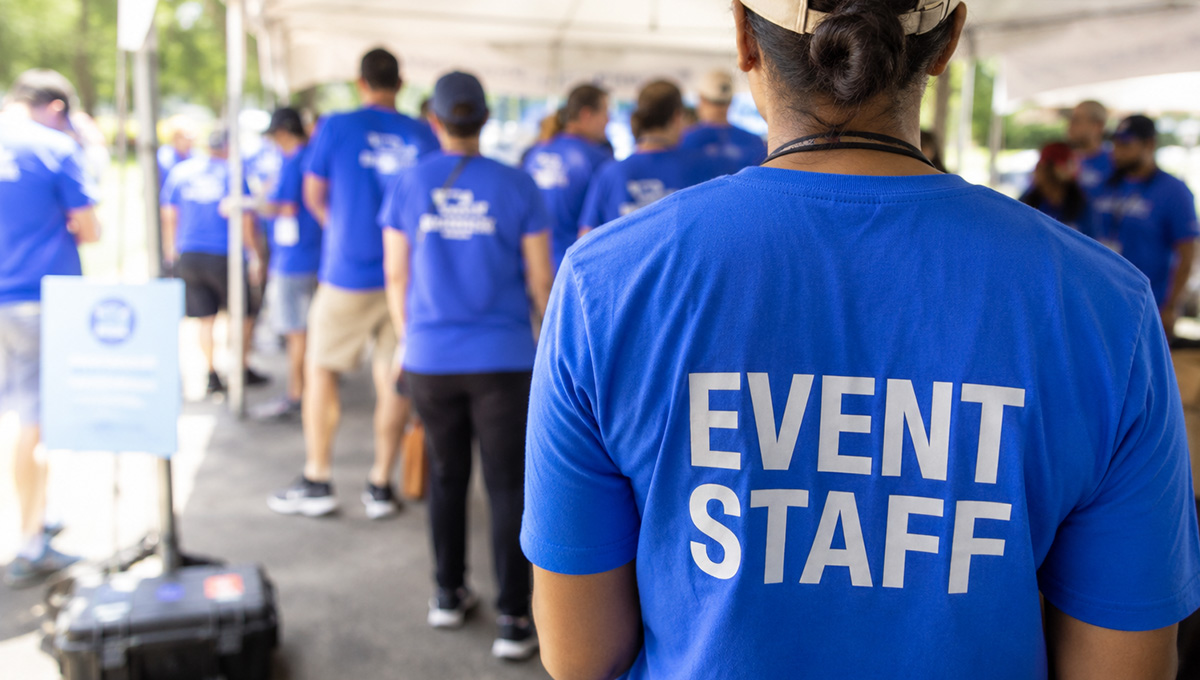
Consider separate apparel for employees, volunteers, vendors, and giveaway recipients. Staff apparel should be visually distinct enough that visitors can quickly identify someone who can help them.
School, Club, and Team Events
Begin four weeks ahead when collecting sizes from several families or departments.
Leave additional time when the design includes student names, graduation years, team numbers, sponsor logos, or several apparel options.
Holiday Events
Order earlier than normal.
Garment inventory, carrier networks, and production schedules can become busier before major holidays. Seasonal apparel such as hoodies, jackets, and winter hats may also experience increased demand.
How to Avoid Delays With Your Custom Shirt Order
A few planning decisions can keep the order moving.
Establish a Real Need-By Date
Tell the decorator when you need the apparel in hand—not only when the event takes place.
Build in time for sorting and distribution.
Finalize Quantities Before Requesting Production
Avoid sending estimates when you are ready to place the order. Confirm the size breakdown and total quantity first.
Send the Best Artwork Available
Do not download a small logo from Facebook or take a screenshot from your website when the original design file exists.
Ask the person who created the logo for the original AI, EPS, PDF, SVG, or high-resolution PNG file.
Respond to Proofs Promptly
Review mockups as soon as they arrive. A proof waiting in an inbox can delay production just as easily as unavailable merchandise.
Check Every Piece of Text
Event dates, sponsor names, website addresses, and phone numbers should be checked before approval.
Keep the Design Practical
A clear design with readable text usually works better than trying to place every possible message on one shirt.
Be Flexible About Comparable Garments
When the first-choice shirt is unavailable, a comparable garment may preserve the deadline without significantly changing the finished look.
Ask About the Deadline Before Ordering
For a time-sensitive order, contact the decorator before placing it. Confirm that the requested garments, decoration method, quantity, and delivery destination can fit the available schedule.
Can You Place a Rush Order for Custom Shirts?
Rush orders may be possible, but they should never be assumed.
At Custom 2 Wear, rush availability depends on production capacity and product availability. Contact us before ordering so the deadline can be evaluated.
A rush order may involve:
- A smaller selection of garment styles
- Limited color choices
- Using readily available products
- A simplified design
- Fewer decoration locations
- Faster artwork approval
- Expedited supplier shipping
- Expedited delivery
- Additional rush-related costs
The fastest solution may not be the exact garment originally requested. When time is short, flexibility becomes one of the most important parts of the order.
Custom Event Shirt Ordering Checklist
Before requesting a quote, collect the following information:
- Event name
- Event date
- Date the apparel must be delivered
- Shipping ZIP code
- Total quantity
- Quantity by size
- Men’s, women’s, youth, or unisex fit
- Preferred garment style
- Preferred garment color
- Budget range
- Logo or artwork file
- Decoration locations
- Approximate design size
- Print or embroidery color preferences
- Sponsor names
- Personalization requirements
- Person authorized to approve the proof
Providing these details at the beginning helps the decorator recommend an appropriate garment, decoration method, and production schedule.
The Best Time to Order Is Before It Feels Urgent
For most events, beginning three to four weeks ahead gives you a practical balance between planning time and production time.
Start even earlier when the order is large, highly personalized, spread across several garment styles, or dependent on several people approving the design.
The goal is not merely to get shirts printed before an event. The goal is to receive the right garments, in the right sizes, with accurate artwork, and enough time to organize and distribute them properly.
Need Custom Shirts by a Specific Date?
Custom 2 Wear provides professional embroidery, screen printing, DTF, and DTG for company events, trade shows, fundraisers, employee outings, schools, teams, community organizations, and promotional campaigns.
Free artwork setup starts at 12 items, and free standard shipping is available on orders of 24 items or more.
When requesting pricing, include your event date, need-by date, quantity, size breakdown, garment preference, decoration locations, shipping ZIP code, and best available artwork.
Request a custom event apparel quote and let us know when the finished apparel must be in your hands.
Frequently Asked Questions About Custom Shirt Order Timelines
How far in advance should I order custom shirts for an event?
For most events, begin the custom shirt ordering process three to four weeks ahead. Start four to six weeks or more in advance for large quantities, specialty garments, complex artwork, embroidery, personalization, or several decoration locations.
How long does it take to receive custom shirts?
Custom 2 Wear states that most orders ship within 6–10 business days. The total timeline can vary based on garment availability, order size, decoration method, artwork approval, production capacity, and delivery time.
Does production begin when I request a quote?
No. Production generally begins after the garments, quantities, sizes, artwork, decoration specifications, payment requirements, and proof approval have been completed.
Can custom shirts be ordered in less than two weeks?
A rush order may be possible depending on product availability and current production capacity. Contact Custom 2 Wear before ordering. Garment choices, colors, decoration locations, or shipping options may be limited.
Does embroidery take longer than shirt printing?
The timeline depends on the design and quantity. Embroidery requires a digitized stitch file and machine sewing time, while screen printing, DTF, and DTG have their own setup and production requirements. A detailed embroidered design or several embroidery locations may require additional time.
When should sizes be collected for an event shirt order?
Set the size deadline several days before the date you plan to approve the order. This gives you time to follow up with missing participants, verify the totals, and add a small number of extra shirts if needed.
Should custom shirts arrive before the event date?
Yes. Plan for the apparel to arrive several days before the event. A larger order may be easier to manage when it arrives approximately one week early, giving you time to inspect, sort, package, and distribute it.