When most business owners think about company uniform branding, they usually start with one thing: the logo. That makes sense. Your logo is the face of your business, and putting it on employee apparel helps customers recognize your team quickly.
But a logo is only the beginning.
The right custom work apparel can do much more than identify your business. It can help build trust, make employees look more professional, create better customer experiences, promote your website, show job roles, and turn every service call into a small branding opportunity.
Whether you run a cleaning company, HVAC business, construction crew, pest control company, restaurant, landscaping business, delivery service, or local contractor team, branded uniforms should be designed with purpose. A shirt, hat, hoodie, or jacket is not just something your employee wears. It is a moving piece of your company image.
Here is what to consider putting on your company uniforms besides just a logo.
Why Company Uniform Branding Matters
Company uniform branding helps your team look organized, trustworthy, and easy to identify. When an employee arrives at a customer’s home, jobsite, office, or business location, apparel is often one of the first things people notice.
A clean polo with a left chest logo sends a different message than an unmarked shirt. A technician wearing a branded hat and jacket looks more official than someone showing up in random clothing. A cleaning team in matching shirts immediately feels more professional and easier to trust.
That is the real value of branded employee apparel. It does not just decorate clothing. It supports your company image before your employee even says a word.
If you are starting with the basics, a professional embroidered logo on polos, hats, hoodies, or work shirts is the foundation. From there, you can add additional details that make your uniforms more useful and more effective.
1. Your Company Logo
Your logo is still the most important part of company uniform branding. It should usually be the first element added to your apparel because it creates immediate brand recognition.
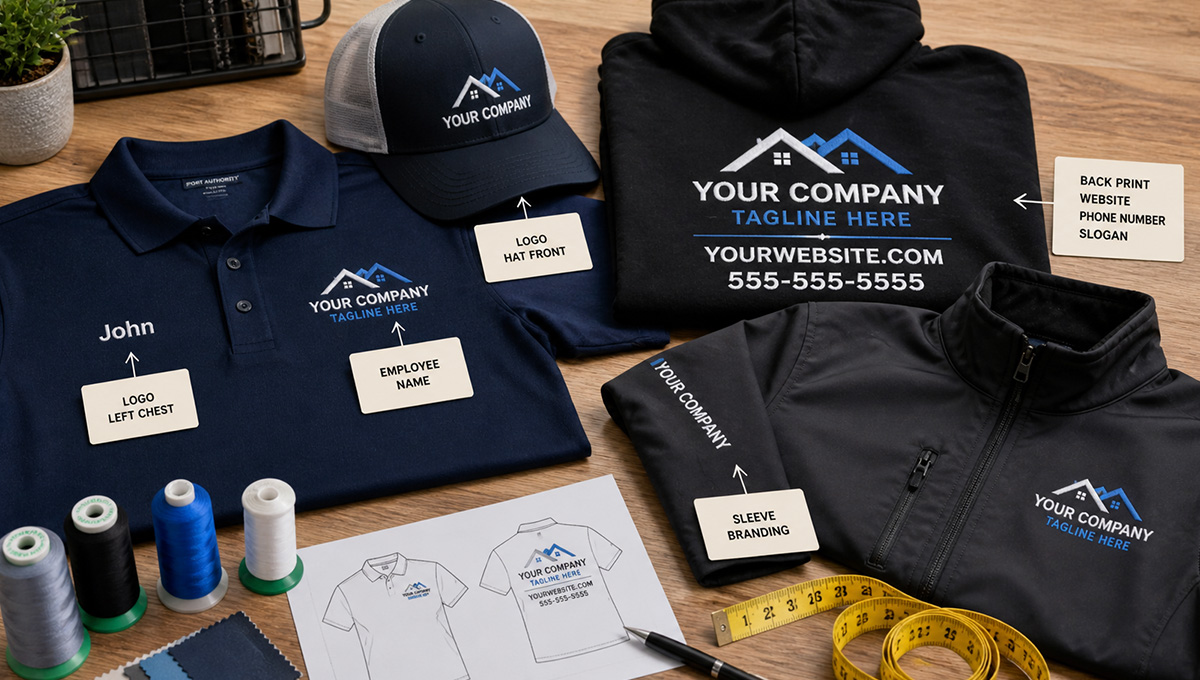
For many businesses, the best logo placement is the left chest area on polo shirts, work shirts, jackets, and hoodies. This placement is clean, professional, and easy to see during face-to-face conversations.
For hats, the front panel is usually the strongest position. A structured trucker hat, baseball cap, or dad hat gives your logo high visibility while keeping your team looking uniform and polished.
Good apparel items for logo branding include:
- Embroidered polo shirts
- Custom trucker hats
- Work shirts
- Hoodies and sweatshirts
- Softshell jackets
- Safety apparel
- Aprons
If your business wants a clean, long-lasting look, embroidery is often the best choice for polos, hats, jackets, and premium uniforms. Printed decoration can also work well for larger designs, back prints, event shirts, and certain casual apparel.
Related: Custom 2 Wear embroidery and apparel decoration services
2. Employee Names
Adding employee names is one of the simplest ways to make uniforms feel more personal and professional. This works especially well for businesses where employees interact directly with customers.
Employee names can be embroidered on the right chest area, opposite the company logo. This creates a balanced look and helps customers feel like they know who they are speaking with.
Names are especially useful for:
- Cleaning companies
- HVAC technicians
- Plumbers
- Electricians
- Pest control professionals
- Restaurant staff
- Office teams
- Retail staff
- Delivery drivers
For home service businesses, names can help reduce uncertainty. If a customer has an appointment with “Mike” or “Sandra,” seeing that name on the uniform helps confirm that the right person has arrived.
For internal teams, names can also help new employees, managers, and customers communicate more easily.
3. Job Titles
Job titles can be very useful when customers need to understand who is responsible for what. A title like “Crew Lead,” “Supervisor,” “Installer,” “Technician,” or “Manager” gives the wearer extra authority and helps customers know who to speak to.
This is especially helpful for businesses with teams working at customer locations or jobsites. For example, a construction company may want supervisors clearly identified. A cleaning company may want team leads marked. A pest control company may want technicians identified by role.
Common job titles used on uniforms include:
- Technician
- Supervisor
- Crew Lead
- Manager
- Installer
- Sales
- Maintenance
- Security
- Event Staff
Job titles are usually placed on the right chest, sleeve, or sometimes below the name. The best placement depends on how much information you want to include and how clean you want the final design to look.
4. Website URL
Your website URL is one of the most overlooked branding elements for employee apparel. If your team is out in public, on jobsites, entering homes, delivering products, or working events, your website can turn the uniform into a simple advertising tool.
The back of a shirt, hoodie, or jacket is a great place for a website URL because there is more room and better visibility from a distance.
For example:
- www.YourCompany.com
- YourCompany.com
- Book Online at YourCompany.com
- Schedule Service: YourCompany.com
In many cases, removing “www” can make the design look cleaner, as long as the website still looks clear and professional. A simple domain on the back of a polo, hoodie, or jacket can be enough.
This works especially well for local service businesses because customers may see your team in neighborhoods, parking lots, office buildings, and jobsite environments.
5. Phone Number
A phone number can be valuable, but it should be used carefully. On some uniforms, too much information can make the apparel look cluttered. On others, especially work shirts, safety shirts, jackets, and back prints, a phone number can make sense.
Phone numbers are often useful for:
- Contractors
- Landscapers
- Pest control companies
- Cleaning companies
- HVAC companies
- Mobile repair services
- Delivery businesses
If you want to include a phone number, the back of the shirt is usually the best location. It gives the design enough room and keeps the front clean and professional.
A simple back layout could look like this:
Company Logo
Professional Service You Can Trust
YourCompany.com | 555-555-5555
For polos and more premium business apparel, you may want to keep the front limited to embroidery and use phone numbers only on casual work shirts or outerwear.
6. A Slogan or Brand Promise
A slogan or short brand promise can give your company uniforms more personality. It tells customers what your business stands for in just a few words.
Examples include:
- Reliable Service. Professional Results.
- Trusted Home Cleaning Since 2005
- Clean Homes. Happy Customers.
- Built Right. Done Right.
- Comfort You Can Count On.
- Protecting Homes. Serving Families.
The key is to keep it short. A slogan should be easy to read, easy to remember, and simple enough to fit on apparel without making the design look crowded.
Slogans work well on the back of shirts, sleeves, or sometimes below the logo if the layout allows it.
7. Sleeve Branding
Sleeve branding is a great option for businesses that want a more premium or modern uniform look. A sleeve can include a small logo, icon, department name, flag, certification, or short phrase.
For example, a company might place the main logo on the left chest and a small icon or website on the sleeve. This gives the apparel more detail without overwhelming the front design.
Sleeve branding works well on:
- Polo shirts
- Long sleeve shirts
- Hoodies
- Jackets
- Performance shirts
For businesses that want a more polished look, sleeve embroidery can make uniforms feel more custom and intentional.
8. Department, Location, or Team Name
If your business has multiple teams, departments, or locations, adding that detail can help keep uniforms organized.
Examples include:
- Chicago Crew
- Service Team
- Installation Department
- Maintenance Division
- Event Staff
- Warehouse Team
- Front Desk
This is helpful for larger companies, schools, event teams, contractors, and organizations with different roles or work groups.
It also helps employees feel like they are part of a specific team, which can support internal culture as well as external branding.
9. Safety or Visibility Details
For some industries, uniforms are not just about branding. They are also about safety, visibility, and jobsite requirements.
Construction crews, road workers, utility teams, warehouse employees, delivery drivers, and certain field service workers may need apparel that keeps them visible in busy or hazardous environments.
In those cases, branding must work with the function of the garment. Logos, names, and company information should be placed in a way that does not interfere with reflective striping, visibility zones, or safety requirements.
For companies working around traffic or construction zones, it is worth reviewing relevant safety guidance from OSHA and industry standards before choosing apparel. You can learn more from OSHA’s interpretation related to high-visibility apparel here: OSHA high-visibility apparel guidance.
Safety apparel can still be branded, but it should be done thoughtfully. The goal is to keep employees visible, compliant, and professional at the same time.
10. QR Codes
QR codes can be useful in some situations, but they should not be overused. They work best on event apparel, promotional shirts, trade show uniforms, or staff shirts where people have time to scan them.
For regular employee uniforms, a website URL is usually cleaner and easier to understand. But for certain campaigns, QR codes can send people directly to:
- A booking page
- A review page
- A product page
- A special offer
- A company profile
- An event registration page
If you use a QR code, make sure it is large enough to scan, printed clearly, and placed on a flat area of the garment.
Best Logo Placement for Company Uniforms
Choosing the right placement is just as important as choosing what to put on the uniform. The goal is to make the apparel look clean, balanced, and easy to read.
Left Chest
The left chest is the classic location for a business logo. It works well on polos, button-down shirts, jackets, hoodies, and work shirts.
Right Chest
The right chest is ideal for employee names, job titles, or secondary branding.
Hat Front
The front of a hat is one of the most visible branding areas. This is ideal for service teams, outdoor crews, contractors, landscapers, and event staff.
Related: Custom Richardson 112 trucker hats with embroidered logos
Sleeve
Sleeves are great for secondary logos, icons, flags, website text, or department names.
Back of Shirt
The back is best for larger information such as a website, slogan, phone number, or large print design.
Embroidery or Printing: Which Is Better for Uniform Branding?
The best decoration method depends on the garment, design, and how the uniform will be used.
Embroidery is a strong choice for logos, names, job titles, hats, polos, jackets, and premium uniforms. It has a clean, professional look and holds up well when done properly.
Printing is often better for large designs, back prints, detailed graphics, full-color designs, and casual work shirts.
Many businesses use both. For example, a company may choose embroidered polos for office staff, embroidered hats for field crews, printed work shirts for summer jobs, and hoodies with a combination of front logo and back print.
Related: Custom embroidered polo shirts for business uniforms
Common Mistakes to Avoid With Company Uniform Branding
Good company apparel should look professional, not overloaded. Here are a few mistakes to avoid:
- Adding too much information: A logo, name, title, phone number, website, slogan, and QR code all on one shirt can quickly become too much.
- Using tiny text: If people cannot read it, it does not help your branding.
- Poor color contrast: Make sure thread or print colors stand out clearly against the garment.
- Choosing the wrong garment: A great logo will not fix an uncomfortable or poor-fitting shirt.
- Ignoring the work environment: Office staff, field technicians, kitchen crews, and construction teams all need different apparel choices.
- Not planning for reorder consistency: Businesses should choose apparel styles that can be reordered when new employees join the team.
Simple Uniform Branding Layouts That Work
If you are not sure where to start, keep it simple. Here are a few proven layouts for small businesses.
Professional Polo Layout
- Left chest: company logo
- Right chest: employee name or job title
- Optional sleeve: small website or icon
Service Business Work Shirt Layout
- Left chest: company logo
- Right chest: employee name
- Back: website and phone number
Contractor or Field Crew Layout
- Hat front: company logo
- Shirt left chest: logo
- Back: slogan, website, or service category
- Outerwear: embroidered logo
Event Staff Layout
- Front: logo or event name
- Back: STAFF, CREW, SECURITY, or VOLUNTEER
- Sleeve: sponsor or organization mark
Final Thoughts: Make Your Uniforms Work Harder
Company uniform branding should do more than display a logo. The right apparel can help customers identify your team, build confidence, promote your business, and create a more professional company image.
Start with a clean logo placement. Then decide whether employee names, job titles, websites, slogans, phone numbers, sleeve branding, or back prints make sense for your business.
The best uniforms are not the ones with the most information. They are the ones with the right information in the right place.
At Custom 2 Wear, we help businesses create professional branded apparel, including embroidered polos, custom hats, hoodies, work shirts, jackets, and complete employee uniform solutions.
Explore custom business apparel options or learn more about our embroidery and apparel decoration services.
Frequently Asked Questions About Company Uniform Branding
What should I put on my company uniforms?
At minimum, most company uniforms should include your business logo. Depending on your industry, you may also want employee names, job titles, website URL, phone number, slogan, department name, or sleeve branding.
Where should a logo go on a company polo shirt?
The most common placement for a company logo on a polo shirt is the left chest. This placement looks professional, is easy to see during customer interactions, and works well for embroidery.
Should employee names be embroidered on uniforms?
Employee names are a good choice for service businesses, restaurants, office teams, and customer-facing employees. Names can make interactions feel more personal and help customers identify who they are working with.
Is it better to embroider or print company uniforms?
Embroidery is usually best for logos, polos, hats, jackets, names, and professional uniforms. Printing is often better for large back designs, full-color graphics, event shirts, and casual work apparel.
Should I put my website on employee uniforms?
Yes, a website can be a smart addition, especially on the back of shirts, hoodies, or jackets. It helps people find your business after seeing your team in the field, at events, or at customer locations.