
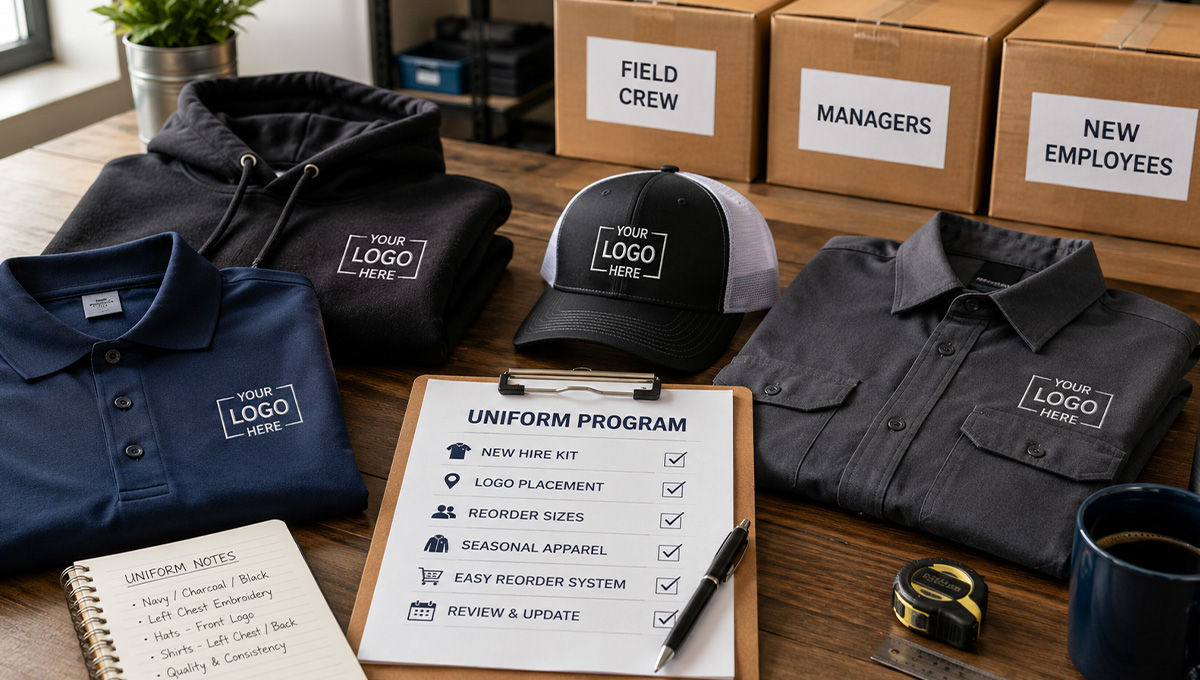
Most small businesses do not start with a uniform program. They start with a few shirts.
Maybe the owner orders polos for the front office. Then a few t-shirts for the field crew. Then hoodies when the weather gets cold. A few months later, someone needs a new size, a new employee joins the team, or the logo gets printed slightly different than the last order.
Before long, the company apparel starts to feel inconsistent.
That is why a simple small business uniform program can make such a big difference. It does not have to be complicated. It does not have to be corporate. It just needs to give your business a clear, repeatable system for how your team should look.
For service businesses, contractors, cleaning companies, restaurants, schools, real estate teams, and local organizations, branded apparel is more than clothing. It is part of how customers recognize and remember your business. The U.S. Small Business Administration has also noted that employee dress can help market a business and build brand awareness, especially when employees are visible in the community or at customer locations. Read the SBA article here.
What Is a Small Business Uniform Program?
A small business uniform program is a simple plan for what your employees wear, how your logo is applied, which apparel items are approved, and how reorders are handled.
Instead of ordering random shirts whenever someone needs something, you create a clear apparel system.
A basic uniform program may include:
- Approved shirt styles
- Approved colors
- Logo placement standards
- Embroidery or printing guidelines
- Seasonal apparel options
- New employee apparel kits
- Reorder quantities and timing
The goal is simple: your team should look professional, consistent, and recognizable every time they represent your business.
Why Random Apparel Orders Become a Problem
Ordering company apparel one order at a time may seem easy at first. But as your business grows, it can create problems.
One shirt may be navy. The next order may be royal blue. One logo may be embroidered on the left chest. Another may be printed too large. One employee may have a polo, another may have a t-shirt, and another may be wearing an old hoodie with a faded logo.
Individually, none of these things seem major. Together, they can make your business look less organized.
A uniform program helps prevent:
- Inconsistent logo sizes
- Mismatched apparel colors
- Employees wearing different-quality garments
- Last-minute emergency orders
- Confusion when onboarding new employees
- Branding that looks different across departments
Consistency matters because customers often judge professionalism before a conversation even begins.
Step 1: Choose Your Core Uniform Pieces
The first step is deciding which apparel items your business actually needs.
Most small businesses do not need a huge uniform catalog. In fact, too many options can create confusion. Start with a few core pieces that cover everyday work, customer-facing situations, and seasonal needs.
A strong starting point may include:
- Logo t-shirts for field crews, events, casual work, or warm-weather jobs
- Embroidered polos for managers, office staff, sales teams, or customer-facing employees
- Branded hats for outdoor crews, contractors, delivery teams, landscapers, and trade businesses
- Custom hoodies or sweatshirts for cooler weather and year-round layering
- Embroidered jackets for a more professional outerwear option
For many small businesses, this is enough to create a clean, practical uniform system.
If your business needs polished customer-facing apparel, start with custom embroidered polos. If your employees work outdoors or need casual branded apparel, add custom Richardson 112 trucker hats and branded work shirts.
Step 2: Pick Colors That Match Your Brand
Color is one of the easiest places for small business apparel to become inconsistent.
If one order is black, the next is charcoal, and the next is navy, your team may still look fine individually. But as a group, the brand starts to look scattered.
Choose one or two main apparel colors and stick with them.
Good uniform color choices usually include:
- Black
- Navy
- Charcoal
- Gray
- White
- Safety colors for certain industries
The best choice depends on your business type. A cleaning company may want a clean, bright color. A contractor may prefer black, charcoal, or safety colors. A restaurant may want something polished and easy to maintain. A landscaping company may lean toward earthy or darker tones.
The key is not just choosing a color you like. The key is choosing a color that supports your brand and can be reordered consistently.
Step 3: Standardize Logo Placement
Logo placement is one of the most important parts of a professional uniform program.
For polos, button-ups, jackets, and many work shirts, the most common placement is the left chest. It is clean, professional, and widely recognized.
For hats, the front panel is usually the main branding area. Depending on the hat and logo design, side embroidery may also be an option.
For t-shirts and hoodies, you may choose:
- Left chest logo
- Full front logo
- Back logo
- Sleeve print or embroidery
Once you choose your placements, keep them consistent.
For example, your uniform standard might be:
- Polos: left chest embroidery
- T-shirts: left chest logo with full back print
- Hoodies: left chest logo or full front logo
- Hats: front embroidery
- Jackets: left chest embroidery
This kind of consistency makes future orders easier and keeps your brand looking sharp.
Step 4: Decide Between Embroidery and Printing
Not every apparel item should be decorated the same way.
Embroidery is usually the best choice for polos, hats, jackets, fleece, and professional workwear. It gives the logo a clean, durable, higher-end appearance.
Printing works well for t-shirts, hoodies, larger graphics, back designs, event apparel, and designs with more detail or larger coverage.
A good employee uniform program may use both.
For example, a contractor may use embroidered hats and polos for a professional look, while also using printed t-shirts for crews working on job sites. A cleaning company may use embroidered polos for team leaders and printed shirts for daily workwear.
If you are unsure which method is best for your logo or apparel type, read our guide on embroidery vs. screen printing for business apparel.
Step 5: Create a New Employee Uniform Kit
One of the best ways to make a uniform program easier is to create a standard new employee kit.
Instead of figuring out what to order each time someone joins the company, decide in advance what every new team member receives.
A simple new employee uniform kit may include:
- 3 branded work shirts
- 1 embroidered polo
- 1 branded hoodie or sweatshirt
- 1 company hat
- 1 jacket if needed for the season or job role
This keeps onboarding organized and makes new employees feel like part of the team from day one.
It also reduces the chance of employees showing up in mismatched or unofficial apparel.
Step 6: Separate Apparel by Role or Department
Not every employee needs the exact same uniform.
In many small businesses, different roles have different apparel needs.
For example:
- Field crews may need durable t-shirts, hoodies, hats, and jackets
- Sales staff may need embroidered polos or button-ups
- Managers may need more polished branded apparel
- Event teams may need matching promotional shirts
- Drivers or delivery crews may need high-visibility apparel
The goal is not to make everyone identical. The goal is to make everyone look like they belong to the same company.
You can do this by keeping the same logo placement, brand colors, and apparel quality across departments.
Step 7: Plan for Seasonal Apparel
A good company uniform program should work year-round.
Many small businesses make the mistake of only ordering short sleeve shirts. Then cold weather arrives, and employees start wearing random hoodies, jackets, and coats over their branded shirts.
That means the logo disappears.
To avoid that, plan for seasonal apparel before you need it.
Consider adding:
- Lightweight work shirts for summer
- Performance shirts for hot weather
- Hoodies or sweatshirts for cooler months
- Softshell jackets for professional outerwear
- Beanies or winter hats for outdoor crews
Custom embroidered sweatshirts and hoodies are especially useful because they keep your team branded when temperatures drop. You can view options here: custom embroidered sweatshirts and hoodies.
Step 8: Keep Reordering Simple
The best uniform program is one you can repeat.
When your business needs more apparel, you should not have to start from scratch. You should already know the approved styles, colors, logo placement, and decoration method.
To make reordering easier, keep a simple record of:
- Product style numbers
- Approved colors
- Logo files used
- Embroidery thread colors
- Print colors
- Logo size and placement
- Employee sizes
This helps prevent mistakes and keeps every new order consistent with the last one.
Step 9: Do Not Overcomplicate the Program
A uniform program should make life easier, not harder.
You do not need twenty shirt styles, ten hat choices, and five hoodie options. Too many choices usually create confusion.
Start with a simple system:
- One main work shirt
- One professional polo
- One hat option
- One hoodie or sweatshirt
- One jacket option if needed
As your company grows, you can expand the program. But in the beginning, simple is better.
Step 10: Make Your Apparel Match the Customer Experience
Your uniforms should match the kind of experience you want customers to have.
If your business wants to look clean, organized, and trustworthy, your apparel should support that. If your company works in rugged outdoor environments, your apparel should look durable and practical. If your team works face-to-face with customers, your uniforms should look polished and approachable.
Branded apparel is not just about putting a logo on a shirt. It is about helping your team represent the business with confidence.
Example Uniform Program for a Small Service Business
Here is a simple example for a local service company:
- Field crew: branded t-shirts, Richardson 112 trucker hats, hoodies, and jackets
- Team leaders: embroidered polos, hats, and softshell jackets
- Office or sales staff: embroidered polos and professional outerwear
- New employee kit: three shirts, one hoodie, one hat
- Logo standard: left chest embroidery for polos and jackets, front embroidery for hats, left chest and back print for t-shirts
This type of system is simple, professional, and easy to reorder.
Final Thoughts: A Uniform Program Helps Your Business Look More Organized
A small business uniform program does not have to be complicated. It just needs to create consistency.
When your team wears the same approved colors, logo placement, and apparel styles, your business looks more professional. Customers recognize your employees faster. New hires are easier to outfit. Reorders become simpler. Your brand becomes more consistent in the real world.
If your business has been ordering random shirts, hats, polos, or hoodies as needed, now may be the right time to create a more organized apparel system.
Custom 2 Wear helps small businesses, contractors, cleaning companies, schools, teams, and local organizations create professional branded apparel that is easy to wear, easy to reorder, and built around your logo.
Need help building a simple uniform program for your team? Contact Custom 2 Wear and we can help you choose the right polos, hats, hoodies, jackets, and work shirts for your business.
Request a custom apparel quote
Small Business Uniform Program FAQs
What is a small business uniform program?
A small business uniform program is a simple system for choosing, decorating, ordering, and reordering company apparel. It helps keep employee uniforms consistent by standardizing shirt styles, logo placement, apparel colors, and approved decoration methods such as embroidery or printing.
How many uniforms should a small business provide each employee?
The number depends on the job and how often employees work, but many businesses start with three to five branded shirts per employee. For full-time team members, it can also be helpful to include a hoodie, jacket, or hat depending on the season and work environment.
What items should be included in a new employee uniform kit?
A basic new employee uniform kit may include branded work shirts, an embroidered polo, a company hat, and a hoodie or sweatshirt. The exact items should match the employee’s role, whether they work in the field, in the office, with customers, or outdoors.
Is embroidery or printing better for company uniforms?
Embroidery is often best for polos, hats, jackets, and professional workwear because it creates a clean and durable logo finish. Printing is usually better for t-shirts, hoodies, large back designs, and promotional apparel. Many businesses use both depending on the garment and how the apparel will be worn.
Why is consistent logo placement important on employee uniforms?
Consistent logo placement helps your business look more professional and organized. When every polo, shirt, hat, or jacket uses the same logo size and placement, your brand becomes easier for customers to recognize and remember.
Free Employee Uniform Policy Template
Download the fillable and printable PDF to create clear uniform, dress code, safety, replacement, and accommodation standards for your small business.